... WhatsApp

A Rare Type of Achalasia May Increase Acid Reflux After Treatment

You are here >> Home > Latest Updates >Achalasia Cardia> A Rare Type…

An Exploratory Endoscopic Achalasia Phenotype With Visible Squamocolumnar Junction and Distal Esophagogastric Junction With Gastroesophageal Reflux Disease After Peroral EndDOI 10

Achalasia is a condition where food has trouble passing from the food pipe into the stomach. This happens because the lower muscle does not relax properly. Patients may feel difficulty in swallowing or food getting stuck.

Doctors often treat this using a procedure called POEM. It helps relax the muscle and improve swallowing.

A new study found a rare type of achalasia that doctors should watch closely.

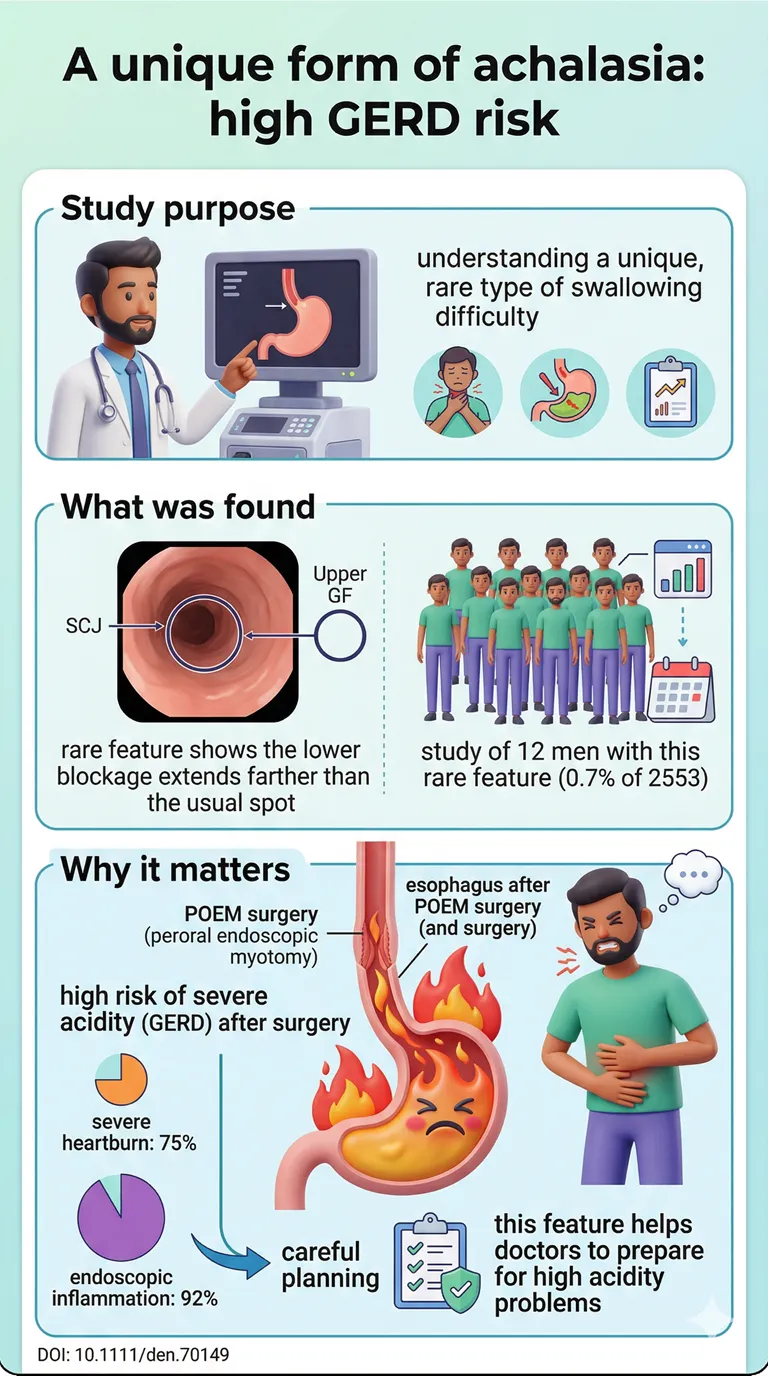
In a small group of patients, doctors noticed a special feature during endoscopy. The lower part of the food pipe and the stomach junction were fully visible. This suggested the blockage was not just in one place, but extended deeper.

This group was very small. Only about 7 in 1000 patients had this pattern. All of them were men.

The key finding is important.

After treatment, most of these patients developed acid reflux. Around 9 out of 10 had visible damage in the food pipe. About 3 out of 4 had confirmed reflux disease.

This is much higher than usual after this procedure.

What does this mean for patients?

If you have achalasia, your doctor may carefully check the structure of your food pipe before treatment.

This helps identify if you fall into this rare group.

Doctors may:

⦿ Monitor you more closely after the procedure

⦿ Start medicines early to control acid

⦿ Adjust treatment planning

Early care can prevent long-term damage from acid reflux.

If you notice symptoms like heartburn, chest discomfort, or sour taste after treatment, report them early.

Awareness of this rare type can help improve outcomes and avoid complications.

Rate this post
Dr. Harsh J Shah
Dr Harsh Shah - GI & HPB Oncosurgeon in India
Privacy Overview

This website uses cookies so that we can provide you with the best user experience possible. Cookie information is stored in your browser and performs functions such as recognising you when you return to our website and helping our team to understand which sections of the website you find most interesting and useful.