Calculate your ideal body weight based on your height and gender
0
kg
0 - 0
kg
Current Weight
- kg
Difference
-
Ideal Weight
- kg
Have you ever wondered, “What is the perfect weight for my height and age?” It’s a question many of us ask. In a world full of health tips and diet plans, finding a simple answer can be confusing. This is where a fantastic tool comes to our rescue: the Ideal Body Weight Calculator.
This guide will explain everything you need to know about this helpful tool. We will explore how it works, why it’s important, and how you can use it to start your journey towards better health. Think of this as your friendly manual to understanding your body better. Using an Ideal Body Weight Calculator is the first step in setting realistic and healthy goals.
⦿ An Ideal Body Weight Calculator is a simple online tool that gives you an estimate of the healthy weight range for your body. It is not just a random number. Instead, it uses a scientific formula that considers important details about you, like your height, gender, and sometimes your age and body frame size.
⦿ The goal of this calculator is to give you a guideline, a starting point to understand what a healthy weight could look like for you. It helps you see if your current weight is in the healthy range, or if you might be underweight or overweight.
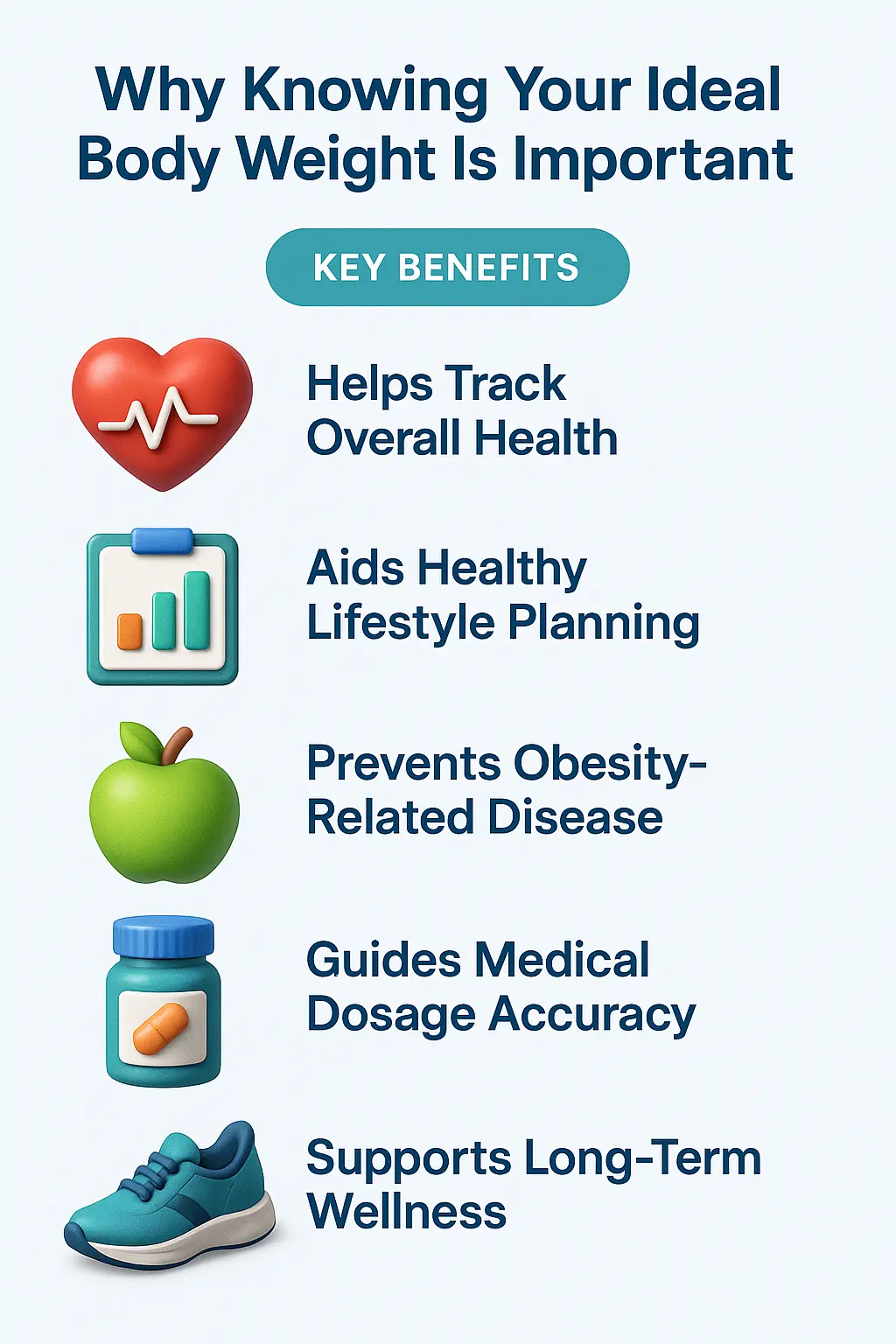
⦿ Gender (Male or Female): Men and women have different body compositions. Men naturally have more muscle mass, while women have a higher body fat percentage.
⦿ Height: This is the most important factor. Your ideal weight is directly related to how tall you are.
⦿ Age: While some basic calculators don’t ask for it, an advanced ideal body weight calculator by age considers that our body composition changes as we grow older.
⦿ Body Frame Size: Some advanced calculators ask for your wrist measurement to determine if you have a small, medium, or large frame.

Exploring the clinical factors that influence healthy weight metrics.
Two people with the same height and weight can look very different. One might be a muscular athlete and the other might have more fat. An Ideal Body Weight Calculator doesn’t directly measure body fat, but it’s a key part of your overall health.
Your daily habits have a huge impact on your weight. This includes:
⦿ Fast food and processed snacks: These are often high in calories and low in nutrients.
⦿ Alcohol: It contains “empty calories” and can lead to weight gain.
⦿ Smoking: While some smokers are thin, quitting can sometimes cause weight gain.
⦿ Sleep: Not getting enough sleep can mess with your hunger hormones and lead to overeating.
⦿ Stress: High stress levels can also lead to weight gain for some people.
Your genes can influence your metabolism and where your body stores fat. Certain medical conditions (like thyroid problems) or medications can also make it harder to manage weight.
| Factor | How It Influences Weight | Simple Explanation for You |
|---|---|---|
| Height | Determines the base range for your weight. | Taller people naturally weigh more than shorter people. |
| Gender | Affects body composition (muscle vs. fat). | Men usually have more muscle, so their ideal weight is often higher. |
| Age | Metabolism and muscle mass change over time. | As you get older, your body burns calories slower, which can affect your weight. |
| Body Frame | Relates to your bone structure and size. | If you have a larger bone structure, your healthy weight will be on the higher end of the range. |
| Muscle Mass | Muscle is heavier than fat. | Athletes may weigh more than non-athletes of the same height but still be very healthy. |

⦿ For Men: 50 kg + 2.3 kg for each inch over 5 feet.
⦿ For Women: 45.5 kg + 2.3 kg for each inch over 5 feet.
⦿ For Men: 48 kg + 2.7 kg for each inch over 5 feet.
⦿ For Women: 45.5 kg + 2.2 kg for each inch over 5 feet.
⦿ For Men: 52 kg + 1.9 kg for each inch over 5 feet.
⦿ For Women: 49 kg + 1.7 kg for each inch over 5 feet.
⦿ For Men: 56.2 kg + 1.41 kg for each inch over 5 feet.
⦿ For Women: 53.1 kg + 1.36 kg for each inch over 5 feet.
This isn’t for finding the ideal weight but for seeing how your current weight compares to it. A percentage of ideal body weight calculator uses the formula: (Current Weight / Ideal Body Weight) x 100. Doctors use this to understand a patient’s nutritional status.

⦿ Find a reliable calculator: Search online for a trusted Ideal Body Weight Calculator.
⦿ Enter your details: You will be asked for your gender, height, and age.
⦿ Measure your height accurately: Stand straight against a wall without shoes. Use a pencil to mark the top of your head and then measure from the floor to the mark.
⦿ Enter your units: Make sure you select the correct units (cm or inches for height, kg or pounds for weight).
⦿ Click “Calculate”: The tool will instantly show you your ideal body weight or a healthy weight range.
⦿ Using the Devine formula: 5’9″ is 69 inches.
⦿ Calculation: 50 kg + 2.3 kg * (69 – 60) = 50 + 2.3 * 9 = 50 + 20.7 = 70.7 kg.
⦿ An online Ideal Body Weight Calculator would give a range, likely around 65-75 kg.
⦿ Using the Devine formula: 6′ is 72 inches.
⦿ Calculation: 50 kg + 2.3 kg * (72 – 60) = 50 + 2.3 * 12 = 50 + 27.6 = 77.6 kg.
⦿ The healthy range would be approximately 72-82 kg.
⦿ Using the Devine formula: 5’6″ is 66 inches.
⦿ Calculation: 45.5 kg + 2.3 kg * (66 – 60) = 45.5 + 2.3 * 6 = 45.5 + 13.8 = 59.3 kg.
⦿ A good range would be about 53-63 kg.
Visual comparison of Devine, Hamwi, Robinson, and Miller calculations for standard heights.
While all four formulas track closely for standard clinical use, the Miller formula often provides the highest estimates, particularly in female populations, which many clinicians regard as more "realistic" for modern body compositions compared to the older Devine standard.
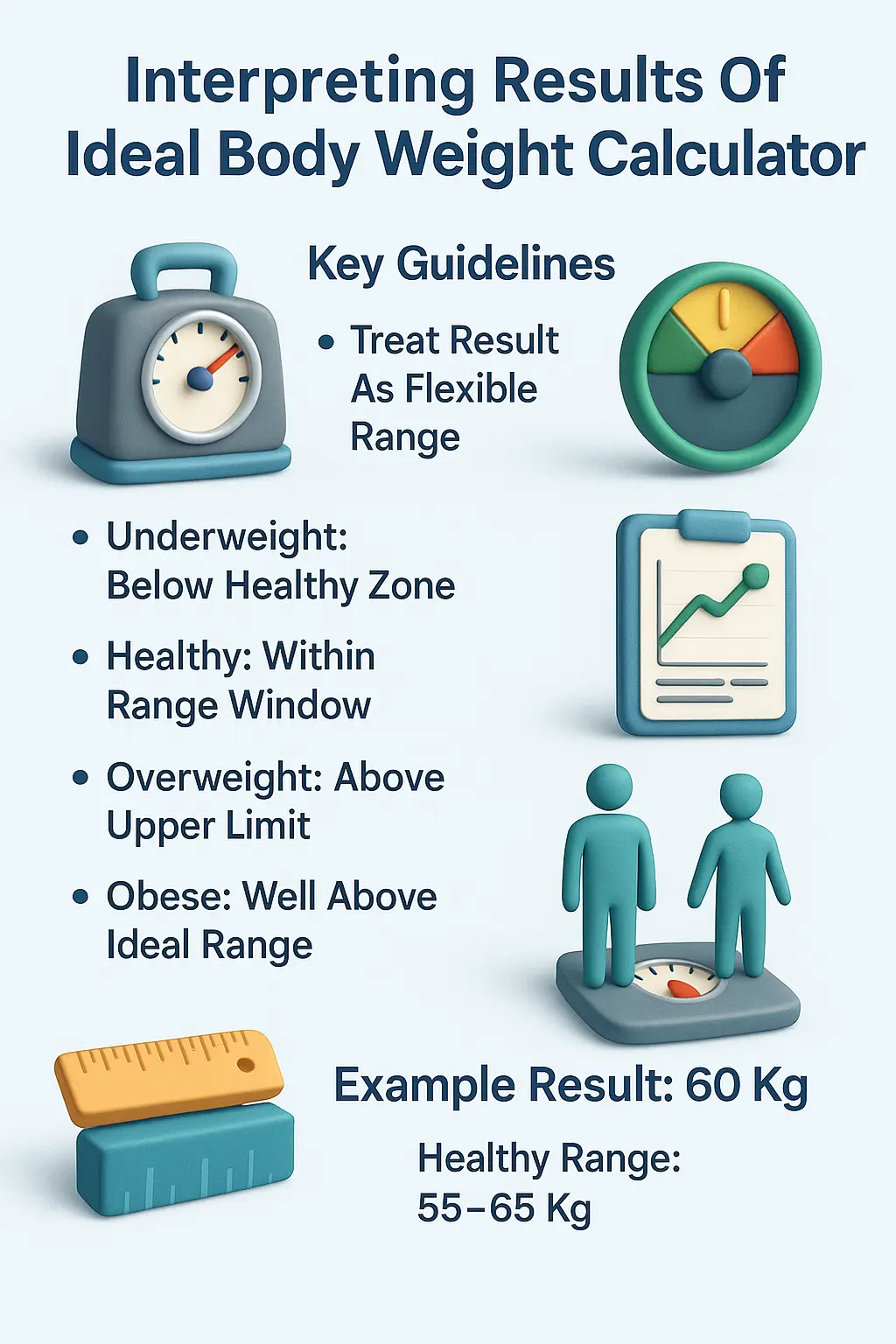
⦿ Underweight: Your weight is below the healthy range.
⦿ Healthy Weight: Your weight is within the ideal range.
⦿ Overweight: Your weight is above the healthy range.
⦿ Obese: Your weight is significantly above the healthy range.
⦿ If you are underweight: You may need to gain weight healthily by eating nutrient-rich foods and building muscle.
⦿ If you are in the healthy range: Congratulations! Your goal is to maintain this weight through a balanced diet and regular exercise.
⦿ If you are overweight or obese: This is a sign that you might benefit from losing weight to improve your health. Small, gradual changes in diet and activity can make a big difference.
⦿ BMI Calculator: The Body Mass Index (BMI) is another popular tool. An ideal weight and bmi calculator will tell you if you are underweight, normal, overweight, or obese based on your height and weight.
⦿ Lean Body Weight Calculator: This tool estimates the weight of your body without fat (muscles, bones, organs). An ideal lean body weight calculator is great for athletes.
⦿ Body Fat Percentage Calculator: This estimates how much of your weight is fat. It provides more insight into your body composition than just weight alone.
⦿ Waist-to-Hip Ratio (WHR): This measures where you store fat. Carrying fat around your belly (apple shape) is linked to higher health risks than carrying it on your hips and thighs (pear shape).
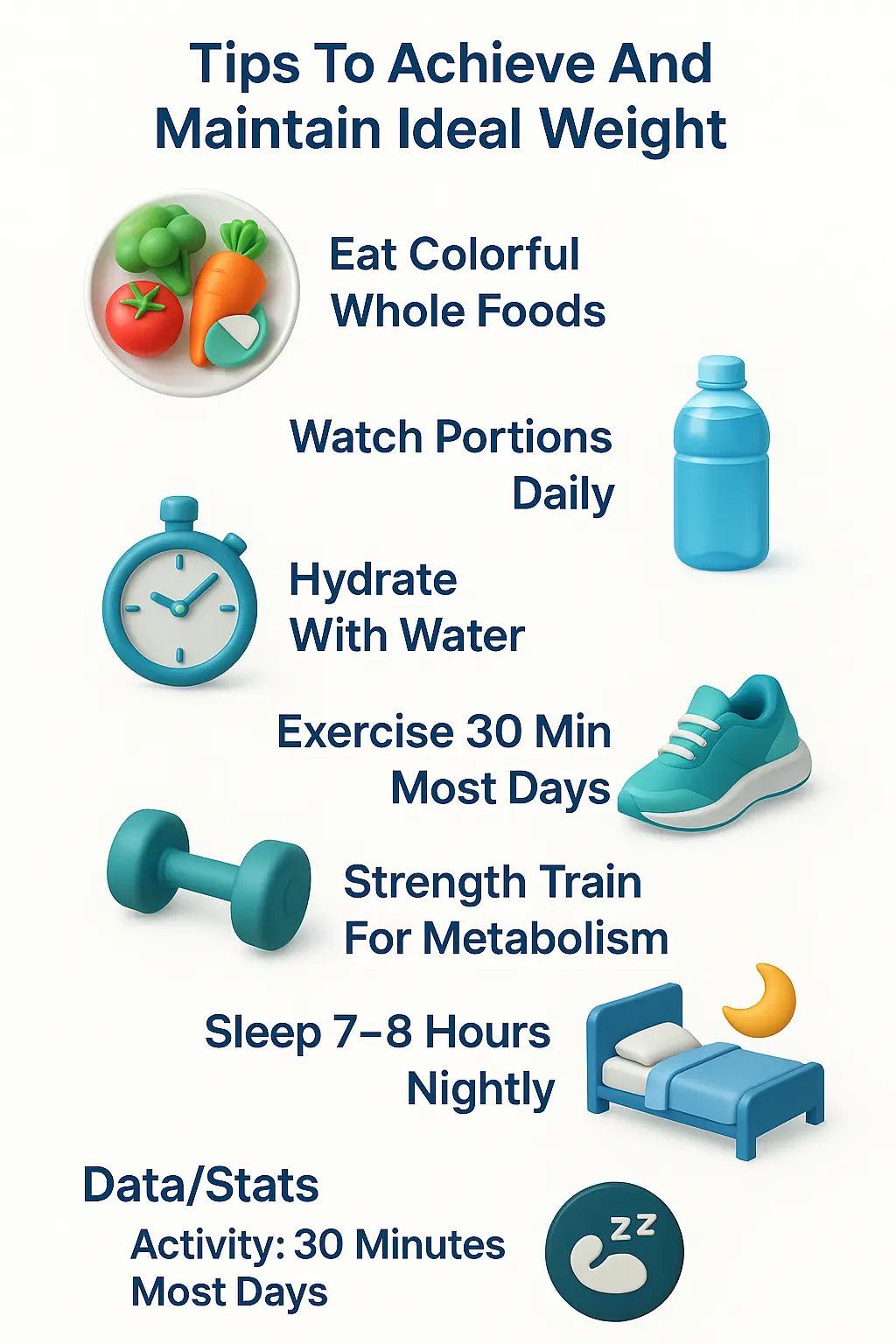
⦿ Eat a variety of foods: Include plenty of fresh fruits, vegetables, whole grains, lean proteins (dal, paneer, chicken, fish), and healthy fats (nuts, seeds).
⦿ Control portion sizes: Use smaller plates and listen to your body’s hunger signals.
⦿ Drink plenty of water: It keeps you hydrated and can help you feel full.
⦿ Limit sugar and processed foods: Avoid sugary drinks, sweets, and packaged snacks as much as possible.
⦿ Aim for at least 30 minutes of activity most days. This can be anything you enjoy: walking, jogging, dancing, cycling, or yoga.
⦿ Include strength training: Building muscle helps boost your metabolism. You can use weights, resistance bands, or your own body weight.
⦿ Get enough sleep: Aim for 7-8 hours of quality sleep per night.
⦿ Manage stress: Try relaxation techniques like meditation, deep breathing, or spending time in nature.
| Habit Area | Specific Action | Why It's Important for Your Health |
|---|---|---|
| Mindful Eating | Eat slowly and without distractions (like TV). | Helps you recognize when you are full, preventing overeating and improving digestion. |
| Hydration | Start your day with a glass of water. | Kickstarts your metabolism and ensures you stay hydrated throughout the day. |
| Daily Movement | Take a 10-minute walk after your meals. | Aids digestion, helps control blood sugar levels, and adds to your daily activity goal. |
| Smart Snacking | Keep healthy snacks like fruits or nuts handy. | Prevents you from reaching for unhealthy, processed snacks when you feel hungry between meals. |
| Consistent Sleep | Go to bed and wake up around the same time every day. | Regulates your body's internal clock, which improves sleep quality and helps manage hunger hormones. |
An ideal body weight calculator is a simple online tool that gives you an estimate of a healthy weight for your body. It uses basic information like your height and gender to provide a weight range that is considered good for your health and well-being.
Females can use a simple formula like the Hamwi method: start with 45.5 kg for the first 5 feet of height. For every inch over 5 feet, add another 2.2 kg. The easiest way, however, is to enter your height into an online calculator for an instant result.
For males, a common formula is to start with 48 kg for the first 5 feet of height. Then, simply add 2.7 kg for each additional inch of height. Using a digital ideal body weight calculator is the quickest and most accurate way to find this.
There are several popular formulas, like the Devine, Hamwi, and Robinson formulas. For example, the Devine formula for men is 50 kg + 2.3 kg for each inch over 5 feet. Online calculators use these formulas to give you a reliable estimate without any manual math.
Most ideal weight formulas are designed to give you the answer directly in kilograms (kg). You just need to know your height in feet and inches. When you use an online calculator, it automatically does the conversion and gives you the final result in kg.
Your height is the most important factor in the calculation. The formulas set a base weight for a height of 5 feet. After that, a specific number of kilograms is added for every extra inch of your height to determine your healthy weight range.
A calculator uses your height to set a basic healthy weight range. It then uses your age to make small adjustments to this range. This is because as we get older, our body composition (muscle and fat) changes, which can influence our ideal weight.
The World Health Organization (WHO) mainly uses the Body Mass Index (BMI) to classify weight. The WHO provides standard BMI charts that show ranges for underweight, normal weight, and overweight. These charts are globally recognized as a standard for assessing adult health.
There is no single "best" formula that fits everyone perfectly. Different formulas like Devine and Hamwi are all widely used and give slightly different, but similar, results. It's best to consider the output of a calculator as a healthy guideline, not a strict rule.
Your ideal body weight is not one exact number but a healthy weight range. This range depends on several factors like your height, gender, and body frame size. The best way to find your personal range is to use a trusted ideal body weight calculator.

MS, MCh (G I cancer Surgeon)
Dr Harsh Shah is a well known GI & HPB Robotic Cancer Surgeon in ahmedabad. He treats cancers of esophagus, stomach, liver, pancreas, colon, rectum & small intestines. He is available at Apollo Hospital.