Skip to main content
Dr Harsh Shah · Pancreas Cancer Surgeon · Apollo Hospital, Bhat, Gandhinagar and Gota OPD, Ahmedabad
A mass in the body or the tail of the pancreas does not announce itself with jaundice. Jaundice belongs to the head of the gland, where a tumour presses on the bile duct and the yellowing sends the patient to a doctor within days. Nothing obstructs in the body or the tail, so the mass is usually found on a scan ordered for something else — pain going through to the back, weight that has been falling for months, or diabetes that appeared for the first time after fifty. And when it is found, it is not automatically cancer. A cystic neoplasm, a neuroendocrine tumour, mass-forming chronic inflammation and a solid pseudopapillary neoplasm all sit in the same part of the gland and can look alike on an ordinary scan. Each is treated differently, and one of them may need no operation at all. What separates them is the order of the tests — and it is the order, rather than the speed, that decides whether the treatment is the right one.
Shah’s Gastro, Cancer & Robotic Surgery Centre
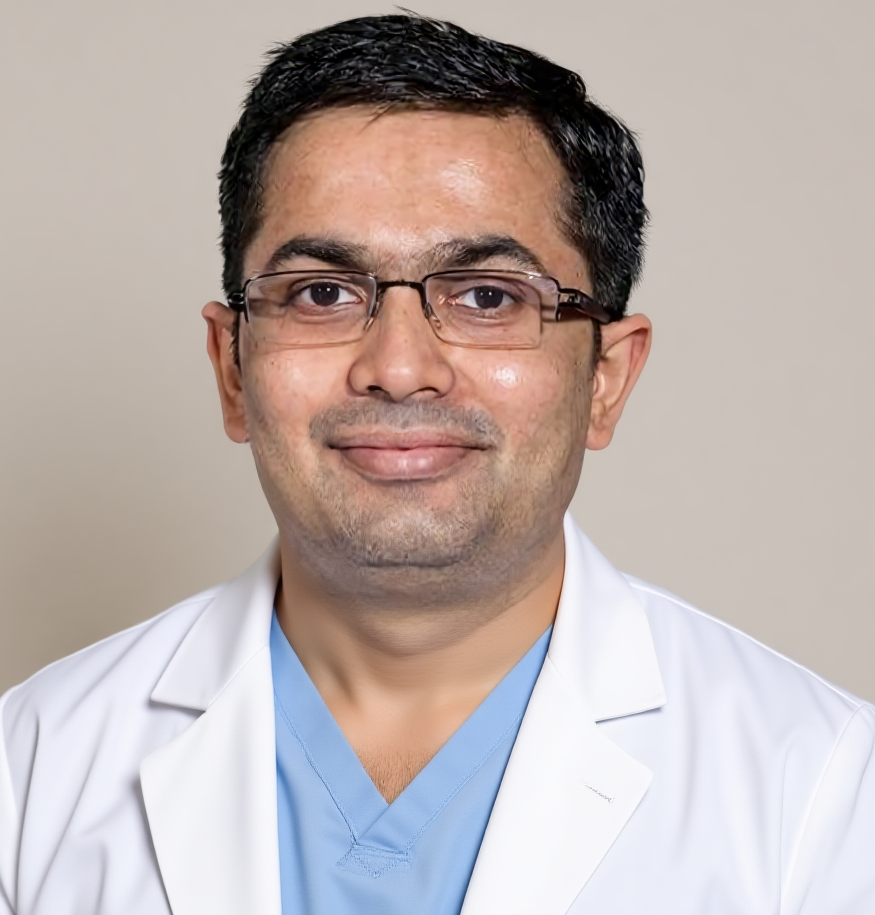
Dr Harsh Shah
MS, MCh (Surgical Gastroenterology), DrNB (Surgical Gastroenterology)
Pancreas Cancer Surgeon
· Apollo Hospital, Bhat, Gandhinagar · Gota OPD, Ahmedabad
Trained at high-volume surgical gastroenterology programmes and qualified twice over in the speciality, Dr Harsh Shah runs a gastro service covering the whole pancreas — the inflammatory diseases as well as the tumours. That breadth is why this page exists: a service treating chronic inflammation, cystic lesions, neuroendocrine tumours and adenocarcinoma in the same clinic has to tell them apart before it treats anything. Google rating 4.89 from 216 reviews at the Gota clinic, and 4.94 from 17 reviews at the Apollo, Bhat listing.
The head of the pancreas sits against the bile duct. A tumour there blocks the duct, the patient turns yellow, and the alarm goes off early and loudly. The body and the tail lie away from the duct and behind the stomach, with nothing to obstruct, so there is no yellow warning at all. What they produce instead are symptoms easy to attribute to something ordinary — which is why most people arriving with a body or tail mass were being investigated for back pain or for new diabetes, not for cancer.
| What the patient notices | Why it happens | What it should trigger |
|---|---|---|
| Upper abdominal pain going straight through to the back, worse lying flat, easier sitting forward | The gland lies against the nerve plexus in front of the spine | Cross-sectional imaging of the pancreas — not painkillers and a review in a month |
| Weight falling steadily with loss of appetite | Reduced enzyme output and the metabolic effect of the tumour | Imaging and nutrition assessment at the same visit |
| Diabetes appearing for the first time after fifty, especially with weight loss | The tumour interferes with the gland’s insulin-producing tissue — a recognised early signal | Image the pancreas; do not settle for a tablet and a repeat sugar |
| A clot in a leg vein with no obvious cause | Pancreatic cancer is among the most clot-prone of all cancers | Look for the cause rather than treating the clot alone |
| Loose, pale, greasy stool that is hard to flush | Enzyme deficiency from a blocked or damaged duct | Enzyme replacement and imaging together |
A report that says "pancreatic mass" or "pancreatic tumour" is a description, not a diagnosis. Several quite different conditions occupy the body and tail, and the standing rule in this practice is that they are never treated as one condition — because the operation that is right for one is unnecessary harm in another.
| What it can be | How it behaves | What treatment looks like |
|---|---|---|
| Pancreatic ductal adenocarcinoma — the cancer most people mean | Solid and infiltrating, and graded for surgery by which blood vessels it touches rather than by how big it is | Surgery and chemotherapy, in a sequence decided by the anatomy on the scan |
| Cystic neoplasm — intraductal papillary mucinous or mucinous cystic neoplasm | Fluid-filled. Some carry a real risk of becoming cancer, others very little; size alone does not decide | Some are removed, many are watched on a defined surveillance interval — a separate pathway with its own rules |
| Neuroendocrine tumour | Different biology altogether, usually far slower, staged on its own system | Its own pathway. Treating it as adenocarcinoma, or quoting the adenocarcinoma outlook to a family, is a serious error |
| Mass-forming chronic inflammation — chronic pancreatitis presenting as a lump | Imitates a tumour closely on imaging, particularly after years of pain or alcohol use | Medical management, enzyme replacement and a pain pathway. Any operation here is aimed at symptoms, not at a tumour |
| Solid pseudopapillary neoplasm | Typically in a young woman, and with an outlook quite unlike adenocarcinoma | Removal, with a conversation that must not borrow the adenocarcinoma script |
A deposit from a cancer elsewhere — a kidney cancer most often — occasionally lands in the pancreas and is managed as that cancer instead. Setting all of this out on a page a patient will read has one purpose: families are routinely handed the outlook for the worst item on this list within hours of the word “mass” being spoken, and before anyone knows which item it is.
There is a correct sequence, and skipping a step in it is the commonest reason a patient ends up with the wrong plan. The first item matters most: an ordinary abdominal CT does not answer the questions that decide treatment, and where it is the only scan available it has to be repeated properly.
A PET scan is not part of the routine work-up; it answers a specific question and is requested for that.
Two rules that pull in opposite directions, which is why they are so often muddled. Tissue is mandatory before any chemotherapy — no drug on the strength of a picture. Tissue is not mandatory before removing a mass the scan already shows to be clearly removable, because the operation is the same whether the needle found cells or missed them.
The third rule matters most to families: a negative biopsy never excludes cancer. A needle passed into a small mass can easily sample the inflamed tissue around it and come back clear. If imaging, marker and clinical picture all point one way, a negative needle does not overturn them — it means the needle missed.
"No operation" is a decision here, not a refusal, and in several situations it is the right one. Saying that plainly is part of the job, because a patient told an operation is not the answer often believes they have been turned away.
Pancreatic cancer is not sorted into early and late for the purpose of surgery. It is sorted by anatomy — by which blood vessels the mass touches, and how much of each vessel's circumference it has reached. That grouping, read off the pancreatic-protocol CT and confirmed at the tumour board, decides the order of treatment.
| Group | What the scan shows | What happens |
|---|---|---|
| Removable | No contact with the major arteries; the vein clear or barely touched | Operation first, chemotherapy afterwards, started as soon as recovery allows |
| Borderline | The vein is significantly involved but rebuildable, or artery contact is limited | Chemotherapy first, the scan read again, then surgery — set out in detail here |
| Locally advanced | The artery is substantially wrapped, or the vein is occluded beyond repair | Chemotherapy first over several months, then re-staging; a proportion of patients become operable |
| Spread | Deposits in the liver, on the peritoneum, or in distant nodes | Systemic treatment, enzymes, nutrition and early palliative involvement. No pancreatic resection |
Two things about that table are worth saying out loud. Every case goes to the tumour board before treatment — whether a tumour is removable is a judgement made by a radiologist, a medical oncologist and the operating surgeon together on the images, not one reader’s opinion, and in this disease the discussion is required rather than optional. And a scan that looks unchanged after chemotherapy has not necessarily failed: CT consistently under-reads the response here, because scar around a vessel and tumour around a vessel look the same. A patient who is well, and whose marker has fallen, is still considered for surgery.
The operation is a distal pancreatectomy: the body and tail of the gland are removed, with the spleen taken out in the same specimen. The head of the pancreas, the bile duct and the duodenum are left alone, which makes this a shorter and less complex operation than the one done for a head tumour.
The spleen comes out for an anatomical reason, not because it is diseased. The lymph nodes draining the body and tail run along the splenic artery and vein on their way to the spleen, and those nodes are part of the field that has to be cleared. Where a lesion is small, benign and well away from those vessels the spleen can sometimes be preserved — decided on the pathology, not on preference.
A distal pancreatectomy is planned surgery, so the paperwork is done properly before admission instead of in a rush. Cashless pre-authorisation is handled by the office at Apollo Hospital, Bhat, and an itemised written estimate is given before you commit to anything; CGHS and corporate panels go through the same office. Cost depends on room category, length of stay and whether chemotherapy comes before or after surgery, so a single figure quoted over the phone by anybody is a guess. Ask for the estimate early — treatment is easier to plan once the financial side is settled.
★★★★★
“My father underwent surgery for pancreas cancer under the care of Dr. Harsh Shah, and we are very satisfied with the treatment. Dr. Harsh Shah is highly skilled, caring, and explained everything clearly before and after the surgery. His confidence and expertise gave us great reassurance throughout the entire journey. The surgery was successful, and my father is recovering well. We are truly grateful for the excellent care and support provided by Dr. Harsh Shah and his team. I highly recommend Dr. Harsh Shah to anyone looking for the best pancreas cancer surgeon in Ahmedabad.”
★★★★★
“We came from Banaskantha for my father's treatment. Dr. Harsh Shah performed his pancreas cancer surgery with great care and professionalism. He explained everything clearly and supported us throughout the treatment. We are grateful for the excellent care and highly recommend him to anyone looking for the best pancreas cancer surgeon in Ahmedabad. Thank you, Dr. Harsh Shah and the entire team.”
★★★★★
“Met with Dr. Harsh Shah for the consultation of one of my relative. Dr. Harsh Shah is an exceptional surgical oncologist in Ahmedabad. His expertise in treating complex GI cancers like liver, pancreas, and colon cancers is truly remarkable. He explains everything clearly and gives patients full confidence in their treatment. Highly recommended for anyone looking for a skilled and compassionate cancer specialist.”
— Gudia Khan, Google review, Apollo Hospital, Bhat listing
— Jay Chauhan, Google review, Gota clinic listing
— Nagesh Patidar, Google review, Gota clinic listing
Not by itself. A cystic neoplasm, a neuroendocrine tumour, mass-forming chronic inflammation and a solid pseudopapillary neoplasm all occur in the same place and can look similar on an ordinary scan. What tells them apart is a pancreatic-protocol CT and, where that leaves the question open, endoscopic ultrasound with sampling. A report saying "mass" is a description, not a diagnosis.
Because jaundice comes from a tumour in the head of the gland blocking the bile duct. The body and tail lie away from the duct, so nothing obstructs and nothing turns yellow. That is why these tumours are found later, and why back pain, unexplained weight loss and new diabetes after fifty deserve a scan of the pancreas rather than reassurance.
Not because the spleen is diseased. The lymph nodes draining the body and tail run along the splenic artery and vein towards the spleen, and those nodes have to be cleared as part of the operation, so the spleen travels with them. In selected small or benign lesions away from those vessels it can be preserved, decided on the pathology rather than on preference.
A negative needle does not exclude cancer — it can easily have sampled inflamed tissue beside the mass instead of the mass. If the imaging and the clinical picture both point one way, the plan does not change on a negative biopsy. It means the needle missed, and the sensible next step is to say so rather than to re-scan in six months.
Shah’s Gastro, Cancer & Robotic Surgery Centre
Gota, Ahmedabad, Gujarat
Google rating 4.89 from 216 reviews
Dr Harsh Shah consults at two addresses: the clinic at Gota, Ahmedabad, and Apollo Hospital at Bhat, Gandhinagar.
Patients travel to Dr Harsh Shah from across Gujarat and from Rajasthan and Madhya Pradesh. Where a mass turns out to need surveillance rather than surgery, follow-up scans can be done closer to home and reviewed here, so distance is not a reason to accept an operation that is not needed.
If a scan has reported a mass in the body or tail of the pancreas, the next step is not an operation — it is the right scan, in the right order. Bring the images, not only the report. Call +91-63555-64601 · WhatsApp Dr Harsh Shah's office
Swasth Parivar: twice a month, practical advice on recovery, diet and warning signs. No advertising. Stop any time.
Your number is used for these updates and for the clinic to reach you. It is never sold or passed on. To stop, reply STOP on WhatsApp.