Skip to main content
Dr Harsh Shah · Pancreas Cancer Surgeon · Apollo Hospital, Bhat, Gandhinagar and Gota OPD, Ahmedabad
Borderline resectable means one thing and one thing only: the tumour is touching or wrapped around a vein — the portal vein or the superior mesenteric vein — while the arteries behind it are clear or very nearly clear. A vein can be removed along with the tumour and rebuilt, provided there is healthy vein above it and below it to join to. So the accurate word for this situation is not inoperable. It is not-yet-operable, and the order of treatment is chemotherapy first, the scan read again, then surgery. Dr Harsh Shah tells you which category your scan actually puts you in, and what has to change before an operation becomes the right move.
Shah’s Gastro, Cancer & Robotic Surgery Centre
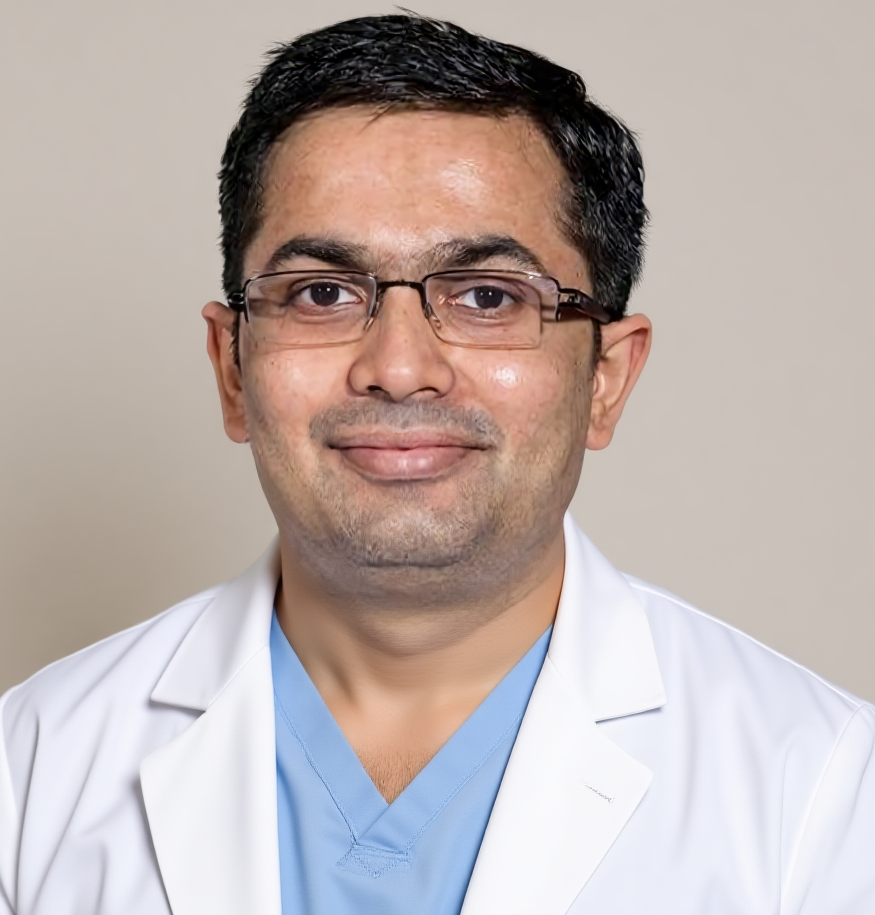
Dr Harsh Shah
MS, MCh (Surgical Gastroenterology), DrNB (Surgical Gastroenterology)
Pancreas Cancer Surgeon
· Apollo Hospital, Bhat, Gandhinagar · Gota OPD, Ahmedabad
Trained at high-volume surgical gastroenterology programmes and qualified twice over in the speciality, Dr Harsh Shah operates on the pancreas as a dedicated part of his practice rather than as one line on a general surgical list. The pancreas is the abdominal organ where the decision — operate, wait, or do not operate at all — is harder than the operation itself, and where getting the sequence wrong costs a patient the one chance at removal. Google rating 4.89 from 216 reviews at the Gota clinic, and 4.94 from 17 reviews at the Apollo, Bhat listing.
Pancreatic cancer is not sorted into early and late for the purpose of surgery. It is sorted by anatomy — by exactly which blood vessels the tumour is in contact with, and by how much of each vessel's circumference it has reached. There are four groups, and the difference between the second and the third is the difference between an operation and no operation.
| Group | What the scan shows | What happens |
|---|---|---|
| Resectable | No contact with the arteries; the vein is free, or touched only along a short arc with a normal outline | Surgery first, chemotherapy afterwards |
| Borderline resectable | The vein is touched along more than half its circumference, or its outline is distorted or clotted, but there is healthy vein above and below to rebuild to; artery contact, if any, is limited | Chemotherapy first, re-scan, then surgery |
| Locally advanced | An artery is encased beyond that limit, or the vein is blocked over a length that cannot be rebuilt | Chemotherapy; a proportion of patients convert and become operable |
| Metastatic | Disease outside the pancreas and its own lymph nodes | Chemotherapy and symptom control; surgery does not help |
Two things follow from that table. A vein is rebuildable and an artery is not — arterial resection exists, but it is not standard practice and Dr Harsh Shah does not offer it as a routine. The whole reason the borderline group is separate is that the vein can be cut across, the tumour lifted away with it, and the clean ends joined or bridged. And borderline resectable describes anatomy, not a prediction about you: it says where the tumour sits, not how the disease will behave, which is what the next few months are designed to find out.
It is also the one situation here where a single opinion is not enough. Resectability is judged by a tumour board reading the images together — radiologist, medical oncologist and operating surgeon — never by one reader writing a report, and in borderline disease it is judged twice: at diagnosis, and again after chemotherapy.
The test that answers the resectability question is a pancreatic-protocol CT: thin slices, two contrast phases timed to the pancreas and then to the veins, reconstructed in several planes. A routine abdominal CT cannot answer it, and if that is the scan you were given it has to be repeated before anybody tells you whether an operation is possible. A large share of the patients who arrive carrying the word inoperable were given it on a scan that could never have established the fact.
Four other things are settled before treatment starts, and each changes something real. Tissue: an endoscopic ultrasound with a needle biopsy, taken from inside the stomach wall. Tissue is mandatory before any chemotherapy and is not mandatory before straightforward removal of a clearly resectable mass — a genuine difference that confuses many families. A negative biopsy never excludes cancer; it means the needle missed. CA 19-9: a marker for following the disease rather than diagnosing it, uninterpretable while the bilirubin is high, so it is repeated once the jaundice is relieved; a minority of people never produce it at all. An MRI or MRCP is added where the CT is equivocal or the duct anatomy needs defining.
A staging laparoscopy — a short look inside with a camera before a major resection — is used for body and tail tumours, a marker disproportionately high with a normal bilirubin, and large or equivocal findings, because deposits too small for any scan are found in a meaningful minority. Germline testing is offered to everyone with this diagnosis: a BRCA or PALB2 result changes which chemotherapy works best and matters to your brothers, sisters and children. And the stent decision: jaundice is not automatically stented, and going straight to theatre unstented is better if surgery is close. But anyone starting with chemotherapy needs drainage first, and it must be a short covered metal stent — plastic ones block over months of treatment and cause an infection in the bile ducts that stops it.
In a borderline resectable tumour the chemotherapy comes before the operation, usually four to six cycles, then a fresh pancreatic-protocol CT and a repeat CA 19-9. It is done in this order for three reasons: it improves the chance of removing the tumour with a clear margin, it gives the disease time to show its hand before a major operation is spent on it, and it means the chemotherapy is actually received — when surgery goes first, only a minority of patients recover well enough and quickly enough to complete it afterwards.
The re-scan carries a trap that is worth knowing in advance, because it is where hope is most often lost unnecessarily. CT under-estimates the response to chemotherapy in this disease. The tumour frequently looks unchanged in size while much of what remains of it is scar rather than cancer. A patient who is well, whose marker has fallen and whose scan looks the same as before has not failed treatment and should still be explored. Reading “no change” as “no benefit” ends the chance of an operation for people who had one.
You are assessed alongside the scan: full-strength combination chemotherapy and a major resection both need a patient who is up most of the day and looking after themselves, and where that is not so a gentler regimen is the right one. Three things run through these months and each is under-done almost everywhere — weight measured at every visit with the dietitian involved early; pancreatic enzyme capsules started at diagnosis and taken with every meal, not before or after it, because under-dosed enzymes are the commonest correctable reason chemotherapy is tolerated badly; and prehabilitation, meaning walking, protein, stopping smoking and alcohol four weeks ahead, and anaemia and blood sugar corrected. This is also among the most clot-prone of all cancers, so blood-thinning cover continues for weeks after surgery.
Which operation depends on where in the pancreas the tumour sits. Head, uncinate process or periampullary region: pancreatoduodenectomy, the Whipple operation. Body or tail: distal pancreatectomy with the spleen taken en bloc, because the lymph nodes along the splenic vessels are part of the field. Where the vein is involved, the affected segment of portal or superior mesenteric vein is removed with the specimen and reconstructed — joined directly, or bridged with a graft. That is appropriate surgery when it is what achieves a clear margin. Arterial resection is a different matter and is not standard.
The quality of the operation is measured on the pathology report, not by how it looked in theatre. A clear margin means the tumour is at least one millimetre from every cut surface, and the margins are reported separately — behind the superior mesenteric artery, the posterior surface, the groove where the vein lay, the cut edges of pancreas and bile duct. At least fifteen lymph nodes are examined, and a standard lymph node clearance is performed and no more, because extending it adds complications without adding benefit. The join between the remaining pancreas and the bowel then decides the week that follows: a soft gland with a narrow duct leaks more often than a firm one, so a drain is left and its fluid tested for pancreatic enzyme on the first morning, and if that is low the drain comes out on about the third day.
Dr Harsh Shah goes through the complications personally, with the figures that apply to you: a leak from the pancreatic join; slow emptying of the stomach, which can mean the nasogastric tube going back and eating delayed by days or weeks, and which settles; a bile leak, a collection needing drainage, a chyle leak, a wound problem, a return to theatre in a small number. And a bleed, which matters most — a small bleed from a drain or the tube that stops on its own and leaves you feeling perfectly well is an emergency. It warns that a vessel is about to give way, and it is never watched overnight. In the longer run most patients need enzyme capsules with every meal for life, a substantial number develop diabetes, eating changes pattern, and a hernia can appear at the scar. Two things belong in that conversation rather than on a page: the risk of not surviving a Whipple depends heavily on how often the operating unit performs it and must be quoted from that unit’s own results, and the operation may be abandoned if deposits are found at laparoscopy or on opening.
Where the answer is no, it is still an answer with a plan. If the vein is blocked over a length that cannot be rebuilt, an artery is encased beyond the limit, or disease is found elsewhere, chemotherapy continues and the scan is repeated, because a proportion of these patients convert. Radiotherapy may be added for local control, persistent back pain is treated with a coeliac plexus block, and jaundice or a blocked stomach outlet is relieved by a stent or a bypass. Palliative care runs in parallel from early on rather than at the end.
Pancreatic surgery is covered by cashless health insurance and by CGHS and corporate schemes at Apollo Hospital, Bhat. What moves an estimate is the operation performed, whether the vein has to be reconstructed, the room category, the length of stay, and whether intensive care is needed — which is why a figure is given to you in writing for your own plan rather than quoted in general on a page.
Pre-authorisation is arranged by the hospital’s insurance desk before admission, and Dr Harsh Shah’s office prepares the clinical justification — which matters more here than in most operations, because anything used to reconstruct the vein has to be described precisely for the insurer to approve it. Bring policy papers and identification, the approval, all imaging, and your regular medicines in their strips. Blood-thinning and diabetes medication need specific instructions before admission; ask for them in writing at the pre-operative visit.
★★★★★
“We are very thankful to Dr. Harsh Shah for successfully performing the Whipple’s procedure. From the beginning, he explained everything clearly and gave us great confidence throughout the treatment. Today, we are happy to share that we received the discharge and are going home with a positive feeling. Thank you, Dr. Harsh Shah, for your expertise, care, and support. Highly recommended for GI surgery. — Desai Sonal, Google review, Apollo Hospital, Bhat listing”
★★★★★
“My father underwent surgery for pancreas cancer under the care of Dr. Harsh Shah, and we are very satisfied with the treatment. Dr. Harsh Shah is highly skilled, caring, and explained everything clearly before and after the surgery. His confidence and expertise gave us great reassurance throughout the entire journey. The surgery was successful, and my father is recovering well. We are truly grateful for the excellent care and support provided by Dr. Harsh Shah and his team. I highly recommend Dr. Harsh Shah to anyone looking for the best pancreas cancer surgeon in Ahmedabad. — Gudia Khan, Google review, Apollo Hospital, Bhat listing”
★★★★★
“Met with Dr. Harsh Shah for the consultation of one of my relative. Dr. Harsh Shah is an exceptional surgical oncologist in Ahmedabad. His expertise in treating complex GI cancers like liver, pancreas, and colon cancers is truly remarkable. He explains everything clearly and gives patients full confidence in their treatment. Highly recommended for anyone looking for a skilled and compassionate cancer specialist. — Nagesh Patidar, Google review, Gota clinic listing”
Real Google reviews from Dr Harsh Shah’s two listings, reproduced exactly as written.
Staging decides which of the four groups above you are in. The video is in Hindi.
Usually, yes. Vein contact is what defines the borderline resectable group, and that group is treated with the intention of removing the tumour: the affected segment of vein comes out with the specimen and is rebuilt. What matters is whether there is healthy vein above and below to join to — answered on a pancreatic-protocol CT, not a routine one.
Because in this group operating first lowers the chance of a clear margin, and chemotherapy given first is chemotherapy actually received — when surgery goes first, only a minority complete the treatment that should follow. Sequence, not speed, changes the result here.
Probably not. CT consistently under-estimates response in pancreatic cancer — the mass often looks unchanged while much of what remains is scar. If you are well and CA 19-9 has fallen, surgery is still considered.
Yes, and specifically so in this disease. Ask which vessel is involved, and whether the scan was a pancreatic-protocol CT. A verdict of inoperable given on a routine abdominal CT, or given for vein rather than artery contact, is worth re-examining.
The tumour board, on the images — a radiologist, a medical oncologist and the operating surgeon together. Resectability is one of the few judgements in cancer surgery where a board discussion is required rather than optional.
Shah’s Gastro, Cancer & Robotic Surgery Centre
Gota, Ahmedabad, Gujarat
Google rating 4.89 from 216 reviews
Dr Harsh Shah consults at two addresses: the clinic at Gota, Ahmedabad, and Apollo Hospital at Bhat, Gandhinagar.
Patients travel to Dr Harsh Shah from across Gujarat and from Rajasthan and Madhya Pradesh. Borderline disease is treated over months rather than weeks, so the chemotherapy is arranged close to home wherever that is possible, with the scans, the board discussion and the surgery here. Send the CT on WhatsApp before travelling and the visit is planned around what the images already show.
If you have been told the tumour is inoperable because it is touching a blood vessel, ask which vessel. A vein and an artery are two different answers, and only one of them closes the door. Call +91-63555-64601 · WhatsApp Dr Harsh Shah's office
Swasth Parivar: twice a month, practical advice on recovery, diet and warning signs. No advertising. Stop any time.
Your number is used for these updates and for the clinic to reach you. It is never sold or passed on. To stop, reply STOP on WhatsApp.