Skip to main content
Ahmedabad and Gandhinagar · Dr Harsh Shah, Stomach Cancer Surgeon
A cancer at the top of the stomach is not simply “stomach cancer higher up”. It sits at the junction where the food pipe meets the stomach, and a single measurement — how far above or below that junction the centre of the tumour lies — decides which operation you are offered, which team leads it, and whether the chest is opened at all. That measurement is the Siewert level. Tumours centred at or just above the junction are treated along the food-pipe pathway; tumours centred below it are treated as stomach cancer, and there the whole stomach usually comes out rather than part of it. Your endoscopy report already contains the number that settles this.
Shah’s Gastro, Cancer & Robotic Surgery Centre
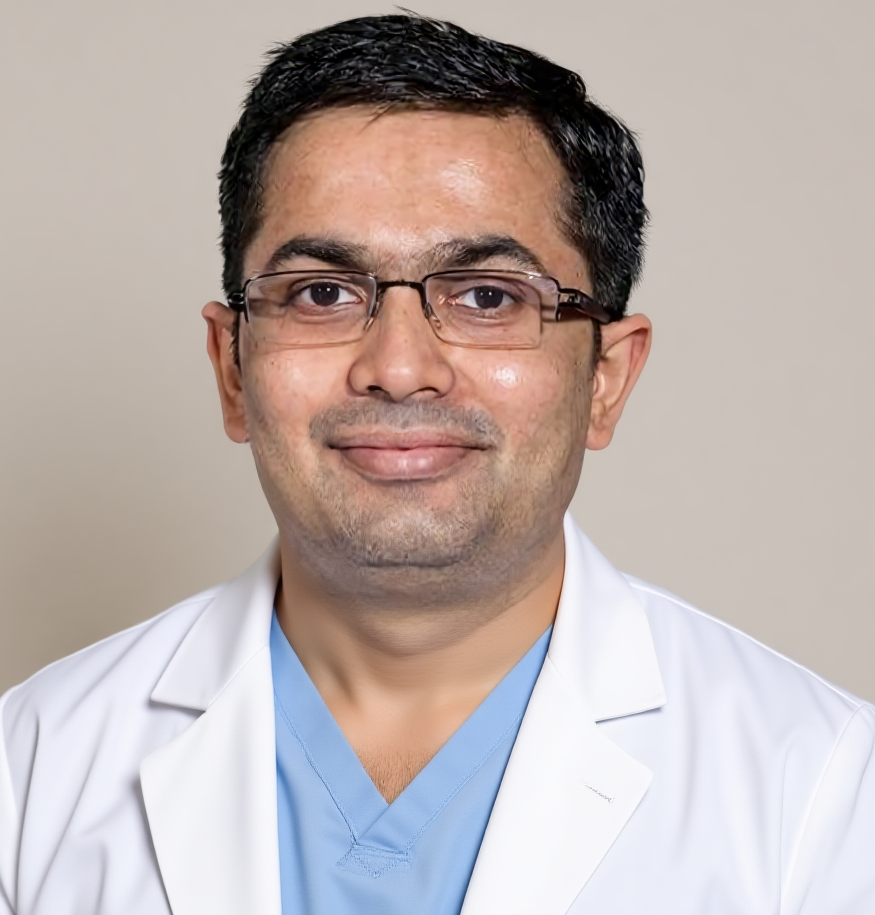
Dr Harsh Shah
MS, MCh (Surgical Gastroenterology), DrNB (Surgical Gastroenterology)
Stomach Cancer Surgeon
· Apollo Hospital, Bhat, Gandhinagar · Gota OPD, Ahmedabad
Qualified twice over in surgical gastroenterology, and in practice long enough to have watched junctional tumours behave differently from tumours lower down in the same organ. A cancer at the gastro-oesophageal junction is the one place in gastrointestinal surgery where two specialties both have a legitimate claim on the operation, and getting the level right before anything starts is what stops a patient from being offered the wrong one. Google rating 4.89 from 216 reviews at the Gota listing, and 4.94 from 17 reviews at the Apollo, Bhat listing.
Proximal gastric cancer means the tumour is in the upper third of the stomach — the cardia and fundus, the part that sits immediately under the diaphragm and receives food from the oesophagus. Because it is so close to the food pipe, a proximal tumour cannot be removed by taking out the lower part of the stomach and joining the rest to the intestine, which is what is done for a tumour in the antrum.
The stomach is usually described in three parts. The antrum is the lower third, nearest the outlet into the duodenum. The body is the middle. The proximal third — the cardia and fundus — is the upper part, and its upper border is the gastro-oesophageal junction, where the food pipe ends and the stomach begins.
That anatomy has a practical consequence. Any cancer operation has to take the tumour out with a margin of normal tissue on either side of it. For a tumour in the antrum, there is plenty of stomach above it to leave behind, so a subtotal gastrectomy works — the lower part goes, the upper part stays, and food passes from the remaining stomach into a loop of small intestine. For a tumour in the proximal third, the margin above the tumour is not stomach at all. It is oesophagus. There is no way to take a clear margin above a proximal tumour without moving into the food pipe.
This is why a proximal cancer is a different operation rather than the same operation shifted upward, and why the first question Dr Harsh Shah asks of a new report is not “how big” but “how high”.
Tumours around the junction are classified by where their centre sits relative to the junction itself. Siewert I is centred above it, in the lower food pipe. Siewert II straddles it. Siewert III is centred below it, in the proximal stomach. Siewert I and II are managed along the oesophageal cancer pathway; Siewert III is managed as a stomach cancer. The distinction is not academic — it changes the operation, the route into the body, and where the join is made afterwards.
| Siewert level | Where the tumour centre sits | Which pathway it follows | What the operation usually is |
|---|---|---|---|
| Type I | Above the junction, in the lower oesophagus | Oesophageal cancer pathway | Oesophagectomy, with the join made inside the chest |
| Type II | Straddling the junction — true cardia | Oesophageal cancer pathway | Oesophagectomy is preferred over an extended stomach operation |
| Type III | Below the junction, in the proximal stomach | Stomach cancer pathway | Extended total gastrectomy, taking a cuff of lower oesophagus |
Two things follow from that table that patients are rarely told plainly. The first is that a Siewert II tumour — the commonest of the three — is treated as a food-pipe cancer even though it sits at the top of the stomach and even though the word “gastric” appears in the biopsy report. The second is that a Siewert III tumour is treated as a stomach cancer even though part of the food pipe will be removed with it. The label on the report and the pathway that follows are not the same thing, and the level is what reconciles them.
Where a tumour sits exactly on a boundary, the decision is made in the multidisciplinary meeting rather than by one surgeon reading one scan. Dr Harsh Shah takes every junctional case to that meeting before a plan is given to the family, because a case that changes pathway after treatment has started has usually changed it late.
Four things are needed before any junctional cancer is planned: an endoscopy that measures distances and takes enough biopsies, a CT scan of the chest, abdomen and pelvis, a blood panel including nutrition markers, and — for most tumours that have grown beyond the inner layers — a staging laparoscopy with washings taken from inside the abdomen. Biomarkers on the biopsy are needed before medicine starts, not after.
| Test | What it settles | When it is done |
|---|---|---|
| Upper GI endoscopy with biopsies | The diagnosis, and the distances that give the Siewert level | First, and repeated only if the first was inadequate |
| CT chest, abdomen and pelvis with contrast | Depth, glands, and whether disease has travelled | Before any treatment decision |
| Biomarkers on the biopsy tissue | Which drugs will work if medicine is needed | Result must be back before the first cycle |
| Staging laparoscopy with peritoneal washings | Whether there is disease on the lining that scans cannot see | Before curative treatment for most junctional tumours |
| Nutrition assessment | Whether feeding support is needed before anything else | At the first visit, not later |
The endoscopy is the one that is most often done without the measurements. A report that says “growth in the stomach, biopsy taken” is a diagnosis but not a plan; a report that records the distance from the teeth to the top of the tumour, the distance to its lower edge, the distance to the junction, the length of the tumour and how much of the circumference it involves is a plan. When that detail is missing, the endoscopy is repeated — not to doubt the first one, but because the number it did not record is the number the operation depends on.
The staging laparoscopy deserves its own sentence. It is a short procedure under anaesthesia in which a camera is passed into the abdomen and fluid is washed in and drawn back out for the laboratory to examine. It finds deposits on the lining of the abdomen that a CT scan cannot resolve. If cancer cells are found in those washings, the disease is treated as though it has spread, whatever the scan showed — and that changes the plan completely, away from an immediate operation and towards medicine. Finding that out before a major operation is very much better than finding it out during one.
Junctional and proximal gastric cancers are rarely treated by surgery alone. For a tumour that has grown through the wall or reached the glands, chemotherapy is given before the operation and again after it. A very early tumour may go straight to surgery. Where disease has travelled beyond the stomach and its glands, medicine is the treatment and an operation does not help.
The ladder has four rungs, and the tests above decide which one you are standing on.
Very early disease. A small tumour confined to the innermost lining, of a favourable type under the microscope, can sometimes be removed endoscopically with no cut. This is uncommon at the junction and is offered only where the criteria are met exactly.
Early disease with clean glands. Surgery first, with chemotherapy afterwards decided by what the pathologist finds in the specimen.
Locally advanced disease. This is the commonest situation at the junction: the tumour has grown through the wall of the stomach or oesophagus, or has reached nearby glands, but has not travelled further. Here chemotherapy is given first, for a defined number of cycles, then the operation, then the remaining cycles afterwards. The reason is not that the surgery is harder without it — it is that treating the whole body early, while the patient is at their strongest, does better over years than operating first and treating afterwards.
Disease that has travelled, or positive washings. Here an operation to remove the stomach is not the treatment. Medicine is, chosen by the biomarkers on the biopsy, alongside nutritional support and symptom control from the beginning rather than at the end. A separate, smaller operation is sometimes still useful — to relieve an obstruction, or to place a feeding tube — and that is a different decision from removing the cancer.
For a Siewert III tumour the standard operation is a total gastrectomy taking a cuff of lower oesophagus with it, together with a formal clearance of the glands around the stomach and its blood vessels. The food pipe is then joined directly to a loop of small intestine. For Siewert I and II tumours the operation is an oesophagectomy, where the join is made higher — inside the chest, or in the neck if the tumour reaches further up.
Three parts of that operation decide how well it works, and they are worth understanding before consent.
The margin above the tumour. The surgeon must leave no cancer at the cut edge of the oesophagus. Because the upper edge of a junctional tumour is often not visible or palpable from outside, a piece of the cut edge is sent to the pathologist during the operation itself and examined while the patient is still asleep. If it is not clear, more is taken. This is routine at the junction and is one of the reasons these operations take longer than a lower gastrectomy.
The gland clearance. The glands along the stomach’s blood vessels are removed systematically rather than picked out selectively, and the specimen is expected to contain a substantial number of them for the staging to be reliable. The spleen and the tail of the pancreas are not removed as a matter of course — that was once standard practice and is no longer, because it added risk without adding benefit.
The reconstruction. After a total gastrectomy the oesophagus is joined to the small intestine, and a second join is made further down so that bile and pancreatic juice meet the food lower in the intestine rather than washing back up. This is what protects against bile reflux afterwards, and it is why a total gastrectomy is a longer operation than simply removing the stomach.
On the approach: keyhole and robotic surgery are established for tumours of the lower stomach, and Dr Harsh Shah performs them regularly there. At the junction the route in — open, keyhole, or through the chest — is chosen for the individual tumour, on its bulk, its level and how far it has grown, and it is named and explained at the consent discussion rather than promised in advance. The organ, the margin and the glands decide the operation; the approach follows them.
There are four situations in which removing a proximal gastric cancer does not help the patient: disease already visible elsewhere on the scan; cancer cells found in the peritoneal washings; a tumour fixed to structures that cannot be safely removed with it; and a patient whose general condition means they would not survive the recovery. In each of those, the honest answer is a different treatment, not a smaller operation.
This is the hardest conversation in the clinic and it is had plainly. An operation that removes the stomach but leaves disease behind takes several months of a person’s life and gives nothing back. Where the tests say the disease is beyond what surgery reaches, the plan moves to drug treatment chosen on the biomarkers, to keeping swallowing open, and to nutrition — and those are real treatments with real results, not the absence of treatment.
Fitness is assessed in its own right, not assumed from age. A person in their seventies who walks daily and has no other illness may be a better candidate than someone twenty years younger with poor heart or lung reserve. Where fitness is borderline, it is often improvable: two to three weeks of walking, breathing exercises, stopping smoking, correcting anaemia and building up nutrition change what is safely possible, and that time is not time lost.
Life without a stomach is manageable and most people return to work and to normal activity, but eating changes permanently: small, frequent meals instead of three large ones, and vitamin B12 by injection for life because the stomach lining that absorbs it is gone. A dietitian is part of the team from before the operation, not called in afterwards.
In the first weeks the volume a person can take at one sitting is small and the number of meals is high. Over some months the intestine adapts and portions grow, though they do not return to what they were. Weight usually falls after a total gastrectomy and then stabilises; the aim is to make that fall as small as possible, which is why nutrition is worked on before the operation rather than after it.
Two effects are worth naming in advance because they surprise people otherwise. Some patients feel weak, flushed or light-headed shortly after eating, particularly after something sweet — this settles with changes to what and how food is taken. And bile can wash back into the food pipe, causing burning; the way the reconstruction is done is designed to reduce this, and where it happens it is treatable. Iron and B12 are checked on a schedule for life, and bone strength is looked at in the longer term.
★★★★★
“We are very thankful to Dr. Harsh Shah for treating and operating on my father for gastric (stomach) cancer. From the first consultation to the surgery and follow-up, he guided us with great care and explained everything clearly. My father is doing well now, and we are extremely grateful for the treatment and support provided by Dr. Harsh Shah and his team. He is a highly experienced and compassionate doctor. We would definitely recommend Dr. Harsh Shah to anyone looking for an experienced doctor for stomach cancer treatment. Thank you, Doctor, for everything! — Moh. Ahsan, Google review, 5 stars”
★★★★★
“Dr Harsh shah's dedication and commitment to his patients health are commendable. He always provides comprehensive explanations and ensures that we understood our treatment plans.Dr harsh shah is best stomach cancer surgeon in Ahmedabad Gujarat. Thank u so much sir for all support and help.🙏 — Haresh Chavda, Google review, 5 stars”
★★★★★
“My father has carcinoma of stomach ,Harsh sir did radical gastrectomy and he is recovering very nicely under Dr.Harsh's observation ,he listen each and every complain calmly and with patience and make patient very comfortable during treatment. — tina parmar, Google review, 4 stars”
These are unedited Google reviews from Dr Harsh Shah’s two listings, from families treated for stomach cancer. They are reproduced exactly as written, including their own spelling.
From the first consultation to full recovery, the pathway for a proximal gastric cancer runs in five steps, and the family is told at each step what the next one depends on.
Proximal gastric cancer surgery is covered by most health insurance policies and by corporate and government schemes at Apollo Hospital, Bhat. What the estimate depends on is the operation itself, the room category, how long the stay runs, and whether chemotherapy is part of the plan. A written estimate is given before admission and cashless approval is applied for on your behalf.
Four things move the estimate: whether the operation is a total gastrectomy or an oesophagectomy; the room category you choose; the length of stay, which is shorter when the recovery pathway runs to plan; and the treatment around the operation — chemotherapy cycles, nutritional support, a feeding tube where one is needed. The office prepares the estimate against your specific plan rather than a general figure, and it is given to you in writing.
For cashless treatment, bring the policy document, the insurance card, photo identity and the previous hospital records. Pre-authorisation is submitted by the hospital’s insurance desk once the plan is fixed, and the office will tell you what the insurer has asked for and when. Where the answer is a partial approval, that is explained before admission rather than discovered at discharge.
It can be treated as either, and the Siewert level is what decides. The cardia is the very top of the stomach, at the junction. If the centre of the tumour sits above or across the junction it follows the food-pipe pathway; if it sits below, it follows the stomach pathway. The word on the biopsy report does not settle it — the measurement on the endoscopy report does.
For a tumour in the proximal third, usually yes. There is no way to leave a useful amount of stomach above a proximal tumour and still take a clear margin, so a total gastrectomy is the standard operation for a Siewert III cancer, with a cuff of lower food pipe taken with it. For a tumour lower down in the stomach it is different, and only part of the organ is removed.
Keyhole and robotic approaches are well established for cancers of the lower stomach. At the junction the route in is chosen tumour by tumour — on its bulk, its level, and how far it has grown — and it is decided with you at the consent discussion rather than promised beforehand. What matters far more to the result is the margin above the tumour and the completeness of the gland clearance, and those are the same whichever route is used.
Because a CT scan cannot see small deposits on the lining of the abdomen, and because fluid washed around the abdomen can be examined for cancer cells that are invisible to any scan. If either is positive, the disease is treated as having spread and the plan changes away from removing the stomach. It is a short procedure, and knowing the answer beforehand prevents a major operation that would not have helped.
For a tumour that has grown through the wall or reached the glands, treating the whole body early — while you are at your strongest and before an operation has taken anything out of you — does better over years than operating first. It also shows how the tumour behaves under treatment, which informs what is given afterwards. Chemotherapy is then continued after the operation, so it is not instead of surgery but around it.
You will eat well, but differently. Small, frequent meals become permanent rather than temporary, and there is a settling period of some months while the intestine adapts and portions grow. Weight falls and then stabilises. Vitamin B12 is replaced by injection for life once the whole stomach has been removed, and iron is checked on a schedule. A dietitian is involved from before the operation.
Shah’s Gastro, Cancer & Robotic Surgery Centre
Gota, Ahmedabad, Gujarat
Google rating 4.89 from 216 reviews
Dr Harsh Shah consults at two addresses in the Ahmedabad–Gandhinagar area: the clinic at Gota, Ahmedabad, and Apollo Hospital at Bhat, Gandhinagar.
Patients travel to Dr Harsh Shah for stomach and junctional cancer treatment from across Gujarat — Gandhinagar, Rajkot, Surat, Vadodara, Bhavnagar, Jamnagar, Junagadh and Kutch — and from Rajasthan and Madhya Pradesh. If you are coming from out of town, send the endoscopy report, the biopsy report and the scans on WhatsApp first, so the consultation is spent on the decision rather than on arranging tests.
Bring the endoscopy report, not just the biopsy result. The distance in centimetres from the teeth to the tumour, and from the tumour to the junction, is what decides the operation. Call +91-63555-64601 · WhatsApp Dr Harsh Shah's office
Swasth Parivar: twice a month, practical advice on recovery, diet and warning signs. No advertising. Stop any time.
Your number is used for these updates and for the clinic to reach you. It is never sold or passed on. To stop, reply STOP on WhatsApp.