Skip to main content
Dr Harsh Shah · Rectal Cancer Surgeon · Apollo Hospital, Bhat, Gandhinagar and Gota OPD, Ahmedabad
Not every rectal cancer needs the rectum removed. In a defined group the tumour disappears completely after chemotherapy and radiotherapy, and the rectum can be kept under close surveillance instead. In another small group a very early tumour is lifted out through the anus. For everyone else, removing the rectum remains the operation that cures. Which group a patient is in is decided by a pelvic MRI, a finger examination and a tumour board — never by preference.
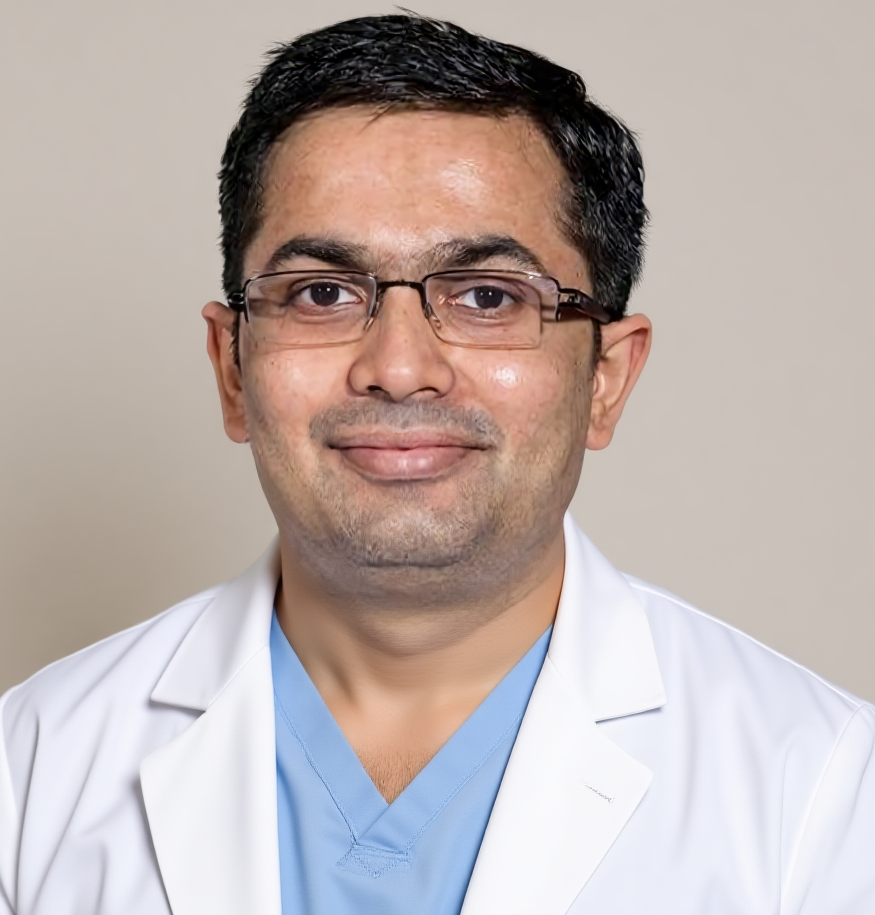
Shah’s Gastro, Cancer & Robotic Surgery Centre
Dr Harsh Shah
MS, MCh (Surgical Gastroenterology), DrNB (Surgical Gastroenterology)
Rectal Cancer Surgeon
· Apollo Hospital, Bhat, Gandhinagar · Gota OPD, Ahmedabad
Qualified twice over in surgical gastroenterology, and in practice long enough to have followed rectal cancer patients well past the operation — through stoma reversal, through bowel function that takes a year to settle, and through the surveillance organ preservation depends on. This is the part of the disease where a surgeon’s honesty matters most: the option is real for some patients and quietly unsafe for others. Google rating 4.89 from 216 reviews at the Gota clinic, and 4.94 from 17 reviews at the Apollo, Bhat listing.
Organ preservation means finishing the treatment for a rectal cancer without removing the rectum, and there are two routes to it. Watch-and-wait: chemotherapy and radiotherapy are given first, and if every trace of the tumour has gone the patient enters intensive surveillance instead of an operation. Local excision: a very small, very early tumour is removed through the anus, leaving the rest of the rectum in place.
This matters in rectal cancer and barely at all in colon cancer, because of anatomy. The rectum stores stool and tells you when to go; removing it changes bowel function permanently, and for a low tumour it may mean a permanent colostomy. That is a price worth paying to cure a cancer. It is not a price worth paying once the cancer has already gone.
Watch-and-wait is not a softer treatment. It is a programme of repeated examinations, scopes and scans with an operation held in reserve, and it is only safe for a patient who will actually come back. Where distance or cost makes three-monthly travel unrealistic, the honest answer is that this option is not available to them — said plainly, rather than offered and then lost to follow-up.
Two things decide whether the rectum can be kept: a digital rectal examination and a pelvic MRI reported to a proper template. The finger tells the surgeon how far up the tumour sits, whether it moves, and whether it has reached the sphincter. The MRI tells what the finger cannot — how deep it has grown, how close it lies to the outer envelope of the rectum, and whether it has invaded the veins around it.
Dr Harsh Shah examines every rectal cancer patient himself at the first consultation. Rectal cancer is diagnosed more often by a finger than by any test, and the distance from the anal verge measured on a rigid scope is the single number that changes which operations are possible — a flexible scope over-estimates it, so the measurement is repeated rather than accepted.
The pelvic MRI is the pivotal test, and a routine report is not enough. What is needed is a synoptic report stating the T stage, the distance from the tumour to the mesorectal fascia — the envelope the surgeon dissects along — extramural venous invasion, nodal status, height from the anal verge, and for low tumours whether the sphincter or levator is involved. Where that is missing the scan is repeated rather than guessed at, because every pathway below is chosen from it.
Alongside it: a full colonoscopy with biopsy to exclude a second tumour in the colon, a staging CT of chest, abdomen and pelvis, a baseline CEA, and MMR or MSI testing on the biopsy. An endorectal ultrasound is added only where local excision is being considered and the MRI cannot separate a very early tumour from a slightly deeper one.
Rectal cancer is treated by MRI risk tier, not by stage alone, and there are three. A good-risk tumour goes straight to surgery. An intermediate-risk tumour is given chemotherapy alone, deliberately leaving pelvic radiotherapy out. A high-risk tumour is given all of its chemotherapy and radiotherapy first — and it is this group in which organ preservation becomes possible.
| MRI risk tier | What the scan shows | Treatment pathway | Can the rectum be kept? |
|---|---|---|---|
| Early / good | A shallow tumour, or a mid-to-high tumour with a clear margin to the mesorectal fascia and no venous invasion | Straight to surgery — total mesorectal excision, no treatment beforehand | Only for a highly selected very early tumour, by local excision |
| Intermediate | A deeper tumour, but the margin to the mesorectal fascia is not threatened | Chemotherapy alone beforehand, pelvic radiotherapy deliberately omitted, then surgery | No — but the long-term damage of pelvic radiotherapy is avoided |
| Locally advanced / high risk | A tumour reaching or crossing the mesorectal fascia, venous invasion, bulky nodes, or a low tumour | Total neoadjuvant therapy — all chemotherapy and all radiotherapy before any operation | Yes, if the tumour disappears completely |
The middle row runs against what most patients expect. Where the margin is not threatened, chemotherapy alone controls the cancer as well as adding radiotherapy does, and it avoids the durable damage radiotherapy causes to bowel, bladder, sexual function and fertility. Radiotherapy is held back for those whose tumour does not respond. Leaving it out is a tumour board decision, never one doctor’s, and never taken where the margin is threatened.
The top row is where organ preservation lives. Total neoadjuvant therapy means giving the radiotherapy and the whole course of chemotherapy before any operation, for a practical reason: patients complete chemotherapy far better before major pelvic surgery than after it. Two schedules are accepted — a short intensive week of radiotherapy then months of chemotherapy, or months of chemotherapy then a longer radiotherapy course with a tablet chemotherapy alongside. Fitness, travelling distance and radiotherapy access decide which, not the tumour alone.
After total neoadjuvant therapy, some patients have no tumour left that anyone can find — no lump on the finger examination, nothing at endoscopy, nothing on the MRI. That is a clinical complete response, and for those patients watch-and-wait is an accepted alternative to removing the rectum. Not a lesser treatment; a different one, with its own demands.
Three tests must agree before the word complete is used: the finger examination finds nothing, the scope sees a flat white scar rather than a lesion, and the MRI shows no residual disease. One disagreeing means the answer is no and the operation goes ahead. There is no partial version of this decision.
What follows is the part patients are rarely told at the outset. Surveillance is a finger examination, an endoscopy and a pelvic MRI every three to four months for two years — the period in which almost all regrowth happens — then six-monthly to five years. Each of those visits carries the possibility of being told the tumour has come back.
If it does come back, the answer is the same operation that would have been done at the start, and regrowth caught on schedule is almost always still removable — which is exactly why surveillance is this intensive. Dr Harsh Shah asks every patient to say that commitment back to him in their own words before the programme starts, because a patient who has not understood it stops attending once they feel well.
Every decision to offer watch-and-wait goes to the tumour board first — surgeon, medical oncologist, radiation oncologist, radiologist and pathologist. That is a rule here, not a courtesy, and the same applies to every plan to leave radiotherapy out.
The second route involves no chemotherapy or radiotherapy at all. A very early rectal cancer — small, shallow, well differentiated, under a third of the circumference, no small-vessel invasion — can be lifted out through the anus, taking the full thickness of the rectal wall beneath it and leaving the rest of the rectum intact. No abdominal incision, no stoma.
The selection is deliberately narrow, because a local excision removes the tumour but not the lymph nodes beside the rectum — so it is only safe where the chance of the cancer having reached them is very low. That is why the MRI and the endorectal ultrasound are both used.
The pathologist’s report on that specimen is the moment the plan can change. If the tumour was deeper than expected, poorly differentiated, or had entered the small vessels, a full removal of the rectum with its lymph nodes follows. That is explained before the local excision, not after: a patient unwilling to accept a second operation on an unfavourable report is not a candidate for the first one.
For most rectal cancers the rectum has to come out, by total mesorectal excision — the rectum removed inside its intact fatty envelope along the natural plane, with a clear margin all the way round and every lymph node that belongs to it. This is the operation that changed the outlook in this disease, and no amount of wishing turns an unsuitable tumour into a suitable one.
Which version depends on where the tumour sits and whether the sphincter is involved. Upper or middle rectum: an anterior resection with the bowel joined back together. Low, sphincter clear: a low anterior resection joined to the anal canal and protected by a temporary ileostomy. Sphincter invaded, or continence already poor: an abdominoperineal excision with a permanent colostomy. A carefully selected low tumour with good continence may instead be removed by an intersphincteric resection.
A temporary ileostomy after a low join is not a sign that something went wrong. It does not prevent a leak — it turns a catastrophic one into a manageable one. Most are reversed at three to six months, once any further chemotherapy is finished and a contrast study confirms the join is intact. A meaningful minority are never reversed, and that is said before the first operation rather than discovered afterwards.
Bowel function is also discussed before the operation, not after. Urgency, frequency, going several times in quick succession and occasional loss of control are common after a low join, and together they are called low anterior resection syndrome. It improves over one to two years with bowel retraining, medication, pelvic floor physiotherapy and rectal irrigation, but it may not disappear. A patient who hears about it for the first time afterwards feels misled, and rightly so.
Two further points. Anyone of reproductive age must have fertility preservation discussed before pelvic radiotherapy starts — it is time-critical and routinely forgotten. And a tumour that has blocked the bowel is treated with a defunctioning stoma first, then the full course of treatment, then the resection: operating on an unstaged obstructing rectal cancer as an emergency is an oncological mistake.
Open, keyhole or robotic is decided by what gives the best specimen in that particular pelvis, and the plane is never compromised for the route. The measure that matters is what the pathologist reports afterwards — an intact envelope and a clear margin — and Dr Harsh Shah treats that report as a personal audit rather than a formality.
★★★★★
“My brother in law operated by Dr harsh shah. After surgery now he is fine. Thank u so much sir. Dr harsh shah is best Rectal cancer surgeon in Ahmedabad." — Kishorbhai Vaghasiya, 5 stars, Dr Harsh Shah, Gota, Ahmedabad”
★★★★★
“One of my relatives was operated on by Dr. Harsh Shah, and we are very happy with the results. After the surgery, she is recovering well and doing great. Dr. Harsh Shah’s expertise, guidance, and care made a big difference throughout the treatment. He is truly the best rectal cancer surgeon in town, and we are grateful for everything he has done. Thanks for truly guidance and support 🙏Highly recommended." — Kamini Chaudhary, 5 stars, Dr Harsh Shah, Gota, Ahmedabad”
★★★★★
“We came from Udaipur, Rajasthan for my husband's rectal cancer surgery. Dr. Harsh Shah performed the operation with great expertise and care. He explained everything clearly and supported us throughout the treatment. The surgery was successful, and we are very grateful for the excellent care we received. Dr. Harsh Shah is one of the best rectal cancer surgeons. Highly recommended!" — Bhupendar Dave, 5 stars, Dr Harsh Shah – Robotic GI Surgeon, Apollo, Bhat, Gandhinagar”
These are unedited Google reviews from patients treated for rectal cancer, quoted word for word from the Dr Harsh Shah listings, including the original spelling and phrasing.
From the first consultation to full recovery there are five stages, and at each one you are told what happens next and when.
No single figure covers rectal cancer: treatment runs over months and the path taken changes what is spent. What can be given is a written estimate for each stage before it happens, and a cashless pre-authorisation where the policy allows.
What moves the estimate: whether radiotherapy is given or left out, how many cycles of chemotherapy are needed, which operation follows, whether a temporary ileostomy is made and reversed as a second admission, the length of stay and the room category. Watch-and-wait avoids the operation but adds a scan, a scope and a consultation every three to four months for two years — that recurring cost is stated up front rather than discovered later.
The office prepares and submits the pre-authorisation before each admission. Bring the policy document and card, photo identity, the MRI and CT on disc, the biopsy and blood reports, and a list of your medicines with doses.
In a defined group, yes. Where chemotherapy and radiotherapy given before any operation have made the tumour disappear completely — nothing on the finger examination, nothing at endoscopy, nothing on the MRI — the rectum can be kept and watched instead of removed. This is not available to everyone, it is decided at a tumour board, and it commits the patient to examinations, scopes and scans every three to four months for two years.
An operation is done, and it is the same operation that would have been done at the start. Regrowth almost always happens in the first two years and is almost always still removable when it is picked up on schedule — which is precisely why the surveillance is so frequent. Missing appointments is the one thing that turns a safe programme into an unsafe one.
Most patients do not. A permanent colostomy is needed when the tumour has grown into the sphincter muscle itself, or when continence was already poor before the cancer. For everyone else the bowel is joined back together, usually with a temporary ileostomy that is closed a few months later. The answer for your own tumour comes from the finger examination and the pelvic MRI, and Dr Harsh Shah gives it at the first consultation rather than leaving it open.
Not necessarily. It depends on what the pathologist found — how deep the cancer went, how well differentiated it is, whether it entered the small vessels, and whether the edges were clear. Where the features are favourable, the polypectomy or a formal local excision can be the whole treatment. Where they are not, a full removal with the lymph nodes follows. Bring the histology report and the colonoscopy images; that report answers the question.
The route matters less than the specimen. Keyhole and robotic surgery are both acceptable for removing the rectum in experienced hands, and the robot has a genuine ergonomic advantage deep in a narrow male pelvis, especially after radiotherapy. What the outcome turns on is whether the envelope around the rectum comes out intact with a clear margin. Dr Harsh Shah chooses the route that achieves that in your pelvis, and converts without hesitation if the plane is being lost.
Shah’s Gastro, Cancer & Robotic Surgery Centre
Gota, Ahmedabad, Gujarat
Google rating 4.89 from 216 reviews
Dr Harsh Shah consults at two addresses in the Ahmedabad–Gandhinagar area: the clinic at Gota, Ahmedabad, and Apollo Hospital at Bhat, Gandhinagar.
Patients travel to Dr Harsh Shah for rectal cancer treatment from across Gujarat — Gandhinagar, Rajkot, Surat, Vadodara, Bhavnagar, Mehsana, Banaskantha and Kutch — and from Rajasthan and Madhya Pradesh. If you are coming from outside Ahmedabad, send the MRI on WhatsApp first and say plainly how often you could realistically travel: that answer is part of the decision about whether the rectum can be kept.
This operation is one part of what a colorectal surgeon does. For the other colon and rectal conditions that are treated, how the first visit works and which reports to bring, read colorectal surgeon in Ahmedabad: what is treated and when to see one.
If you have been told the only option is a permanent bag, ask whether a pelvic MRI has been done and reported properly. That one report decides whether organ preservation is even on the table. Call +91-63555-64601 · WhatsApp Dr Harsh Shah's office
Swasth Parivar: twice a month, practical advice on recovery, diet and warning signs. No advertising. Stop any time.
Your number is used for these updates and for the clinic to reach you. It is never sold or passed on. To stop, reply STOP on WhatsApp.