Skip to main content
Dr Harsh Shah · Pancreas Cancer Surgeon · Apollo Hospital, Bhat, Gandhinagar and Gota OPD, Ahmedabad
An adult who turns yellow without pain and without fever has a tumour in the head of the pancreas until something else is proved. Painless jaundice is almost always read the other way — a liver problem, hepatitis, a gallstone that has slipped down — and the first thing that happens is an endoscopy with a plastic stent to bring the bilirubin down. Sometimes that is exactly right. Often it is the step that makes everything afterwards harder: the scan that decides whether the tumour can be removed is more difficult to read once a stent and the inflammation around it are in the way, the plastic tube blocks, the patient returns with fever, and an operation that could have happened in a fortnight slips by a month. The order of the first three decisions — which scan, whether to drain, then the operation — matters more here than the speed of any one of them.
Shah’s Gastro, Cancer & Robotic Surgery Centre
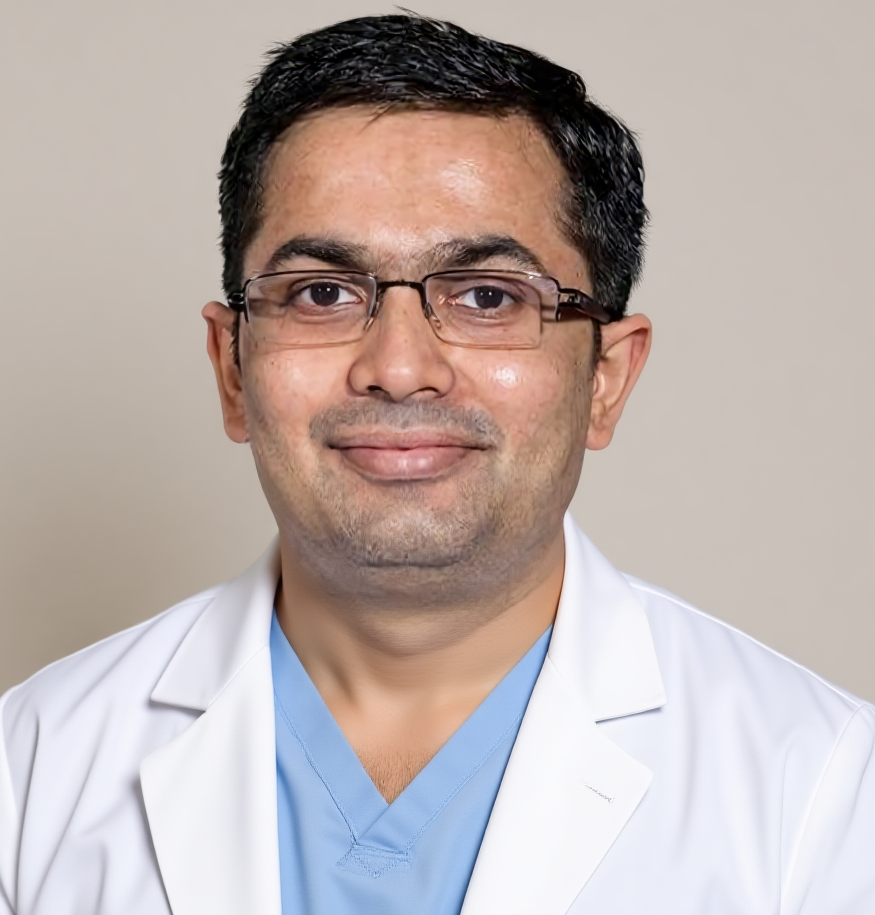
Dr Harsh Shah
MS, MCh (Surgical Gastroenterology), DrNB (Surgical Gastroenterology)
Pancreas Cancer Surgeon
· Apollo Hospital, Bhat, Gandhinagar · Gota OPD, Ahmedabad
Qualified twice over in surgical gastroenterology and trained in high-volume units, Dr Harsh Shah runs a service covering the whole pancreas together with the bile duct and the duodenum that sit against the head of the gland. Jaundice with a head mass is the one presentation where the surgeon, the endoscopist and the radiologist must agree a sequence before anybody acts — and a service that does the scan, the endoscopic ultrasound, the drainage and the operation under one roof can agree it in days rather than in referrals. Google rating 4.89 from 216 reviews at the Gota clinic, and 4.94 from 17 reviews at the Apollo, Bhat listing.
A gallstone stuck in the bile duct hurts, and usually brings fever with it. A tumour in the head of the pancreas presses the duct shut slowly and painlessly, so the first thing anyone notices is the colour — yellow eyes, dark urine, pale stool, and an itch that keeps the patient awake long before anything aches. Painless jaundice in an adult earns an urgent pancreatic scan, not a course of liver tablets and a review in three weeks.
Four other presentations belong on the same list and each is routinely put down to something ordinary: pain going through to the back and easing on sitting forward, because the gland lies against the nerve plexus in front of the spine; weight falling with appetite gone; diabetes appearing for the first time after fifty with weight loss, a recognised early signal of this cancer rather than simply age; and an unprovoked clot in a leg vein, because this cancer is among the most clot-prone there is.
There is a correct sequence, and skipping a step in it is the commonest reason a patient ends up with the wrong plan. The first item carries the most weight: an ordinary abdominal CT does not answer the question that decides treatment, and where it is the only scan available it has to be repeated properly — ideally before anything is placed inside the bile duct.
A PET scan is not part of the routine work-up. And every case goes to the tumour board before treatment starts, without exception: whether a tumour can be removed is a judgement made by a radiologist, a medical oncologist and the operating surgeon together on the images, not one reader’s opinion.
A blocked bile duct does not have to be drained before surgery. The standing rule here is that a stent is placed for a reason and never reflexively — and if the operation can happen within about two weeks and the patient is otherwise well, the right answer is usually to go to surgery with the jaundice still present and deal with the blockage by removing its cause.
Draining first is correct in a defined set of situations, and in those it is not optional:
When a stent is placed, what kind it is matters as much as whether. A short self-expanding metal stent stays open; a plastic tube reliably blocks, and the patient who returns with fever three weeks later is usually the patient given plastic because it was quicker. Where chemotherapy is planned before surgery, a covered metal stent is the one that survives the course. Alongside that decision, four things are corrected in parallel rather than afterwards: the clotting, which deep jaundice disturbs and vitamin K restores; anaemia; the blood sugar; and the enzymes. Pancreatic enzyme replacement is started at diagnosis in anybody with greasy stool, weight loss or an obstructed duct, taken with meals rather than before or after them. It is the most under-prescribed treatment in this disease, and it matters beyond comfort — a patient who cannot absorb food does not hold weight, and a patient losing weight tolerates chemotherapy badly.
The operation for a tumour in the head of the pancreas is a pancreatoduodenectomy, known everywhere as the Whipple. It has two halves: a resection taking the head of the gland with everything that shares its blood supply, and a reconstruction joining the digestive tract together again in three places. The second half determines the recovery.
What comes out: the head of the pancreas, the whole duodenum, the gallbladder and the lower bile duct, the lymph nodes of that territory, and — depending on the version chosen — the outlet of the stomach. The classical operation and the pylorus-preserving version are oncologically equivalent, so the choice is made on the anatomy in front of the surgeon rather than sold as a better operation. What goes back together: the remaining pancreas to the small bowel, the bile duct to the small bowel, and the stomach or duodenum to the small bowel.
"No operation" is a decision, not a refusal, and saying so plainly is part of the job — because a patient told that surgery is not the answer very often believes they have been turned away. Four quite different reasons lead to four different plans.
Recovery after a Whipple runs to a pathway, not to guesswork. The patient sits out of bed on the day of surgery, the nasogastric tube comes out at the end of the operation rather than days later, clear fluids start the same evening, and the drain fluid is tested the next morning. That one test largely decides the week: if it is reassuring, the drains come out on the third day and the diet moves on.
A Whipple is planned surgery, so the paperwork is done properly before admission rather than in a rush. Cashless pre-authorisation is handled by the office at Apollo Hospital, Bhat; CGHS and corporate panels go through the same office; and an itemised written estimate is given before you commit to anything. Cost turns on room category, length of stay, whether a stent and an endoscopic ultrasound come first, and whether chemotherapy precedes or follows surgery — so a single figure quoted over the phone by anybody is a guess. Ask for the estimate early: treatment is easier to plan once the financial side is settled.
★★★★★
“We are very thankful to Dr. Harsh Shah for successfully performing the Whipple’s procedure. From the beginning, he explained everything clearly and gave us great confidence throughout the treatment. Today, we are happy to share that we received the discharge and are going home with a positive feeling. Thank you, Dr. Harsh Shah, for your expertise, care, and support. Highly recommended for GI surgery.”
★★★★★
“My father underwent surgery for pancreas cancer under the care of Dr. Harsh Shah, and we are very satisfied with the treatment. Dr. Harsh Shah is highly skilled, caring, and explained everything clearly before and after the surgery. His confidence and expertise gave us great reassurance throughout the entire journey. The surgery was successful, and my father is recovering well. We are truly grateful for the excellent care and support provided by Dr. Harsh Shah and his team. I highly recommend Dr. Harsh Shah to anyone looking for the best pancreas cancer surgeon in Ahmedabad.”
★★★★★
“We came from Banaskantha for my father's treatment. Dr. Harsh Shah performed his pancreas cancer surgery with great care and professionalism. He explained everything clearly and supported us throughout the treatment. We are grateful for the excellent care and highly recommend him to anyone looking for the best pancreas cancer surgeon in Ahmedabad. Thank you, Dr. Harsh Shah and the entire team.”
— Desai Sonal, Google review, Apollo Hospital, Bhat listing
— Gudia Khan, Google review, Apollo Hospital, Bhat listing
— Jay Chauhan, Google review, Gota clinic listing
Because of what is missing. Jaundice from a liver illness or from a stone in the duct usually brings pain, fever or a history that fits. Yellow that arrives quietly, with itching and pale stool and no pain at all, points to the duct being squeezed shut from outside — and the head of the pancreas is what sits against it. In an adult, that combination is treated as a pancreatic head tumour until a proper scan shows otherwise.
Sometimes, and sometimes not. With fever, unbearable itching, failing kidney function, or an unavoidable delay before surgery, draining the duct first is correct. If the operation can happen within a fortnight and the patient is well, going straight to surgery is usually better, because a stent and the reaction around it make the decisive scan harder to read. Two questions settle it: has a pancreatic-protocol CT already been done, and if a stent is going in, is it metal rather than plastic.
No. A needle passed into a small mass can easily sample the inflamed tissue beside it and come back clear, so a negative result means the needle missed rather than that nothing is there. Tissue is essential before any chemotherapy, but it is not required before removing a mass the scan already shows to be clearly removable — the operation is the same either way.
Enzyme replacement with every meal should be assumed rather than feared: it is a tablet, it works, and it is what protects weight and the ability to complete chemotherapy. Diabetes may appear or worsen because part of the insulin-producing gland is removed, so sugars are monitored with a written plan from discharge. Both are discussed at consent, with the figures that apply to your own situation, rather than discovered afterwards.
Shah’s Gastro, Cancer & Robotic Surgery Centre
Gota, Ahmedabad, Gujarat
Google rating 4.89 from 216 reviews
Dr Harsh Shah consults at two addresses: the clinic at Gota, Ahmedabad, and Apollo Hospital at Bhat, Gandhinagar.
Patients travel here from across Gujarat and from Rajasthan and Madhya Pradesh. Because jaundice with a head mass is time-sensitive, the scan reading and the drainage decision can be given on images sent ahead, so a family travels once — for the consultation and the work-up together — rather than three times.
If the eyes and the urine have changed colour and there is no pain, ask for imaging of the pancreas before anyone puts a stent in. Send the reports and the images the same day. Call +91-63555-64601 · WhatsApp Dr Harsh Shah's office
Swasth Parivar: twice a month, practical advice on recovery, diet and warning signs. No advertising. Stop any time.
Your number is used for these updates and for the clinic to reach you. It is never sold or passed on. To stop, reply STOP on WhatsApp.