Skip to main content
Shah's Gastro, Cancer & Robotic Surgery Centre · Ahmedabad & Gandhinagar
Cancer in the middle of the stomach — the body and greater curvature — assessed and treated by Dr Harsh Shah at Apollo Hospital, Bhat, Gandhinagar and the Gota OPD, Ahmedabad.
A cancer in the body of the stomach is the one place where the choice between removing part of the stomach and removing all of it is genuinely open — and that single decision, made from the distance to the food pipe and the type of cancer under the microscope, shapes the operation, the recovery and how you will eat afterwards. It is not a decision to be taken in theatre by default. It is taken before admission, explained, and written down.
Shah’s Gastro, Cancer & Robotic Surgery Centre. A practice built on the stomach, the food pipe and the pancreas rather than on general surgery with an interest in them. Qualified in surgical gastroenterology as a specialty in its own right, and operating on the upper gastrointestinal tract week after week.
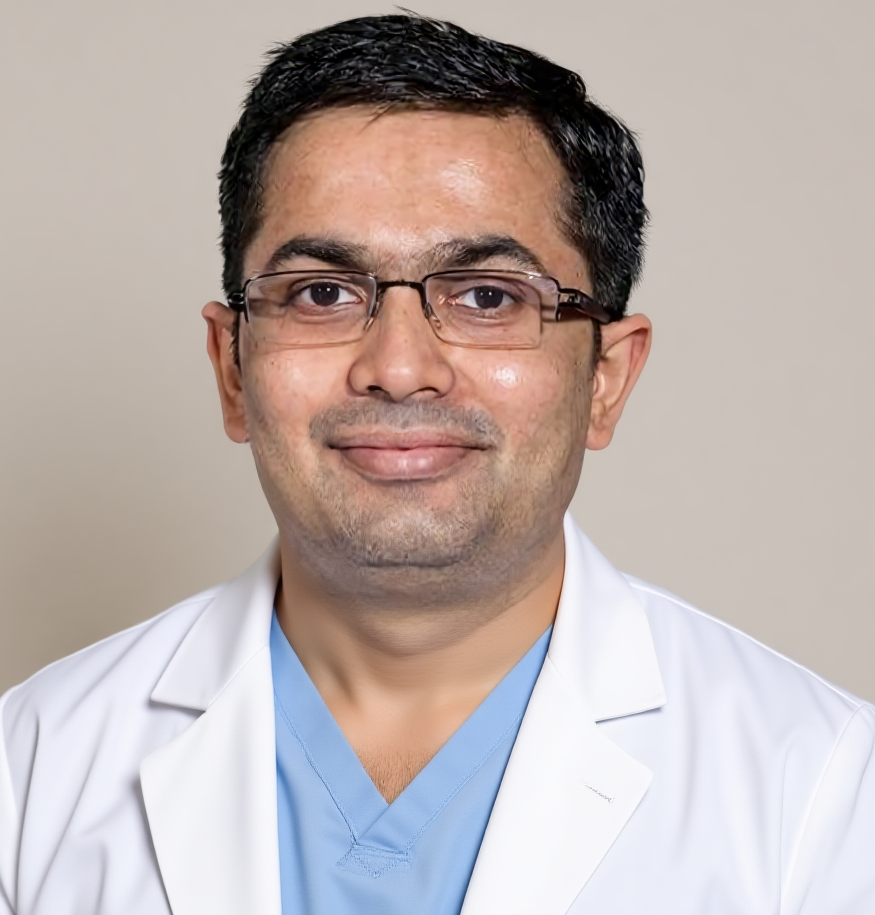
Dr Harsh Shah
MS, MCh (Surgical Gastroenterology), DrNB (Surgical Gastroenterology)
Stomach Cancer Surgeon · Apollo Hospital, Bhat, Gandhinagar · Gota OPD, Ahmedabad
Google rating 4.89 from 216 reviews at the Gota clinic, and 4.94 from 17 reviews at Apollo, Bhat.
The body is the large middle chamber of the stomach, between the antrum below and the fundus above. A cancer here rarely blocks anything, so it does not announce itself — and by the time it does, the question is no longer whether to operate but how much stomach can honestly be left behind.
A tumour in the lower stomach narrows the outlet, and the patient vomits. A tumour in the body sits in a wide, stretchy chamber with nothing to obstruct. So the early signs are quiet and easy to explain away: feeling full after half a meal, vague discomfort under the breastbone, tiredness, and — most often of all — iron-deficiency anaemia from slow bleeding the patient never sees. Many people arrive having been treated for months for acidity, or investigated for anaemia by everyone except an endoscopist.
Two features of this position matter surgically. The first is the distance upward: the cancer must be far enough below the junction with the food pipe to leave a clear margin above it and still keep a usable stomach. The second is the lymph node drainage. Tumours of the body and greater curvature drain towards the nodes at the hilum of the spleen and along the splenic artery — territory a lower-stomach cancer does not involve — and clearing that territory properly, without removing the spleen to do it, is the technical heart of the operation.
There is also the diffuse type, which infiltrates the wall rather than forming a lump. At its extreme it produces linitis plastica, a stomach that has turned into a rigid, thickened sac. It spreads further through the wall than any scan or endoscopic photograph shows, and that fact alone removes the option of a partial resection.
Not every thickening or ulcer in the body of the stomach is an adenocarcinoma, and the operations for the alternatives are completely different. This is established with biopsies first, not with a scan and an assumption.
A long-standing benign gastric ulcer, a GIST, a gastric lymphoma and a neuroendocrine tumour can all look similar on a report and all sit in the body of the stomach. A GIST is removed with a clear margin and no lymph node dissection at all, and is often treated with targeted tablets before surgery. A gastric lymphoma is usually treated without an operation. A neuroendocrine tumour is graded and staged differently and may be watched. A benign ulcer is healed medically, tested for Helicobacter pylori, and re-scoped to prove it has healed.
That is why the first step is an endoscopy with at least six biopsies from the edge of the lesion, not from its floor — and why a single negative biopsy in a suspicious stomach is repeated rather than believed.
Four questions have to be answered before a plan exists: what it is, how far it has gone, whether the lining of the abdomen is involved, and whether the patient is strong enough for the whole pathway rather than only the operation.
| Test | What it decides |
|---|---|
| Endoscopy with six or more biopsies | Proves the diagnosis and its type — intestinal or diffuse. Records the distance up to the junction with the food pipe and down to the pylorus. This measurement, more than anything else, decides partial versus total removal |
| CT scan of chest, abdomen and pelvis with contrast | Extent in the wall, the lymph nodes, and spread to the liver, lungs or elsewhere |
| Staging laparoscopy with peritoneal washings | A direct look at the abdominal lining for deposits too small for any scan. Cancer cells in the washings are treated as spread, even when everything else looks operable — and that changes the plan entirely |
| Bloods and a nutrition assessment | Haemoglobin, albumin, weight change. Losing more than a tenth of body weight in six months, or an albumin below 3, triggers feeding support before chemotherapy rather than after it fails |
| Biomarkers — HER2, PD-L1, MSI | Needed only for advanced disease, and needed before the first cycle of systemic treatment, not after it |
| Endoscopic ultrasound | Only when it would actually change the decision — an early lesion, or a borderline depth |
A PET scan is not part of the routine work-up for stomach cancer and is not ordered as a reflex here.
Every case is discussed in a multidisciplinary meeting before definitive treatment starts. That is not a formality. Whether to operate first or give chemotherapy first is a meeting’s decision, and so is the reverse — recognising the patient who should not be operated on at all.
Treatment for a body cancer runs from an endoscopic resection with no cut at all, through chemotherapy and surgery together, to treatment aimed entirely at control and comfort. Most patients sit in the middle of that ladder, and a few sit at either end.
A very early cancer — confined to the innermost lining, small, well differentiated and not ulcerated — can be removed endoscopically, from inside the stomach, with no incision and no stomach removed. It is uncommon in India because so few cancers are found that early, but it is real, and it is missed when a biopsy report is read without its measurements.
Most operable cancers are treated with chemotherapy before and after surgery — the modern pattern is four cycles, then the operation four to six weeks later, then four more cycles. This is not an add-on to the operation; the combination does better than surgery alone, and it is the reason the first appointment is about a pathway rather than a date.
Where cancer cells are found in the abdominal lining or the washings, an immediate gastrectomy does not help and may harm. Treatment becomes systemic, guided by the biomarkers, with surgery reconsidered only if the disease responds convincingly.
Where the disease has spread, the aim shifts to controlling it and protecting nutrition and comfort — chemotherapy matched to HER2, PD-L1 or MSI status, a bypass or a stent if the stomach obstructs, and palliative care brought in early rather than at the end. Not operating, when that is the honest answer, is a decision Dr Harsh Shah will give you plainly and in writing.
Where the patient is not currently fit for the full pathway, the answer is often “not yet” rather than “no” — two to three weeks of feeding, iron correction and walking practice can move someone from a modified regimen to the full one.
For a body cancer, a subtotal gastrectomy is performed when a clear margin of at least five centimetres can be achieved above the tumour and enough usable stomach remains. When it cannot, or when the cancer is the diffuse type, the whole stomach is removed and the food pipe is joined directly to the small bowel.
Four judgements separate an adequate operation from a good one.
How much stomach. The margin above the tumour must be at least five centimetres of normal stomach for the common intestinal type, and wider for the diffuse type. Where there is any doubt, the margin is checked by frozen section during the operation — the pathologist looks at it while the patient is still asleep — rather than being assumed and discovered afterwards. Leaving a small, tense remnant of stomach to avoid the word “total” serves nobody.
The lymph node clearance. A D2 dissection clears the nodes beside the stomach and the deeper stations along the left gastric, common hepatic and splenic arteries. For a body or greater-curvature tumour this includes the nodes along the splenic artery, which is the part most often left undone. At least 15 nodes must reach the pathologist and the target is more than 25 — fewer than that and the stage itself becomes unreliable. The spleen and the tail of the pancreas are not removed to achieve it; that was older practice, and it added complications without adding survival.
The reconstruction. After a subtotal, the stomach remnant is joined to a loop of small bowel as a Roux-en-Y. After a total, the food pipe itself is joined to the small bowel — an oesophagojejunostomy — which is the more demanding join of the two and the one that governs how carefully the first post-operative week is watched. A feeding jejunostomy is placed in the same operation when nutrition is already poor, so that feeding never depends on appetite.
The approach. Keyhole and robotic surgery are well established for cancers of the lower stomach. For a body cancer the decision is made case by case, and the open approach is still the right judgement for a bulky tumour, one growing into a neighbouring structure, the diffuse type, and many total gastrectomies. Dr Harsh Shah decides this from the scan and the findings, tells you what is planned before admission, and tells you what would change it.
★★★★★
“We are very thankful to Dr. Harsh Shah for treating and operating on my father for gastric (stomach) cancer. From the first consultation to the surgery and follow-up, he guided us with great care and explained everything clearly. My father is doing well now.”
Moh. Ahsan · Google review, Apollo Hospital, Bhat
★★★★★
“Dr Harsh Shah's dedication and commitment to his patients' health are commendable. He always provides comprehensive explanations and ensures that we understood our treatment plans.”
Haresh Chavda · Google review, Gota, Ahmedabad
★★★★★
“My father has carcinoma of stomach, Harsh sir did radical gastrectomy and he is recovering very nicely under Dr. Harsh's observation. He listens to each and every complaint calmly and with patience and makes the patient very comfortable during treatment, during the procedure and during the stay at hospital.”
Tina Parmar · Google review, Gota, Ahmedabad
Shared with the patient’s written consent. Every patient’s course differs; this is one person’s experience, not a promise of outcome.
After a subtotal gastrectomy most patients get back to a normal range of food in smaller, more frequent meals. After a total gastrectomy there is no reservoir at all, so the pattern of small frequent meals is permanent, and vitamin B12 by injection is lifelong and not optional.
Expect six small meals rather than three large ones, certainly for the first year. Some patients get dumping — weakness, sweating or palpitations twenty minutes after something sweet or milky — which is managed by changing what and when you eat rather than with medicine. A bitter taste and morning nausea from bile reflux affects a minority. Weight usually falls over the first three months and then settles; the dietitian’s job is to make that a plateau rather than a slide, which is why the referral is made before the operation and not after the first lost kilogram.
After a total gastrectomy, B12 is given by injection every three months for life because the part of the stomach that allows it to be absorbed is gone. Iron and calcium are monitored, and bone density is worth checking in the years that follow. None of this is a complication. It is the arithmetic of the operation, and it is much easier to accept when it was explained beforehand.
The estimate is built for the individual patient and given in writing before admission. It is not quoted over the telephone, because for a body cancer the single largest variable — subtotal or total — is not settled until the staging is complete.
What moves the figure: whether the operation is open, laparoscopic or robotic; whether the whole stomach has to be removed; whether a feeding jejunostomy is placed; the room category you choose; and how many nights, if any, are spent in intensive care. Chemotherapy before and after the operation is costed separately from the surgery itself.
The Apollo insurance desk handles cashless pre-authorisation for all major insurers and TPAs. Send the policy card and the treating doctor’s papers as soon as surgery is planned — pre-authorisation takes working days, and a late approval moves the date. Bring on admission: policy documents and photo identification, every previous report and scan in original, a current medication list including anything for blood pressure, diabetes or blood thinning, and one family member who will stay.
For a cancer in the body of the stomach, that is the central question rather than a formality. If at least five centimetres of healthy stomach can be left above the tumour and the remnant will be usable, a subtotal gastrectomy is performed. If the tumour sits high in the body, or if it is the diffuse type that infiltrates the wall well beyond what is visible, a total gastrectomy is the honest operation. The endoscopy measurements and the biopsy type decide it, and you will be told which is planned before admission and what finding in theatre would change it.
A cancer in the body of the stomach commonly bleeds slowly and invisibly. The blood is digested rather than seen, so the first sign is a falling haemoglobin with no other symptom. Iron-deficiency anaemia in an adult, particularly over 55 or with any weight loss or early fullness, warrants an endoscopy before another course of iron tablets.
Not routinely, and not in order to clear lymph nodes. The nodes at the splenic hilum and along the splenic artery are cleared with the spleen left in place. Removing the spleen and the tail of the pancreas to achieve that clearance was older practice; it increased complications without improving survival. The spleen is removed only if the tumour directly involves it.
Sometimes, and it is decided case by case rather than promised in advance. Keyhole and robotic surgery are firmly established for cancers of the lower stomach. For a body cancer, a bulky tumour, one invading a neighbouring organ, the diffuse type, and many total gastrectomies are better served by the open approach — and the cancer clearance, not the size of the incision, is what decides.
Most patients leave hospital between the fourth and sixth day. Light activity resumes within two weeks, and desk work at about three. If chemotherapy follows, that becomes the rhythm of the next few months, and the recovery is best measured by what you can eat and how far you can walk rather than by the calendar.
That is treated as spread, even though nothing was visible on imaging, and an immediate gastrectomy would not help. Treatment becomes systemic and biomarker-guided, and surgery is reconsidered only if the disease responds convincingly. This is precisely why the staging laparoscopy is done before the major operation rather than at the start of it.
Yes, and no reasonable surgeon objects to one. What makes it worth the time is bringing the actual material — the biopsy slides and blocks, the CT images on a disc rather than the report alone, and the endoscopy report with its measurements. A second opinion given on a summary letter is an opinion about a letter. A fortnight spent getting the plan right is not a fortnight lost.
Shah’s Gastro, Cancer & Robotic Surgery Centre — Gota, Ahmedabad
Consultations, review of reports, follow-up and surveillance.
Google: Dr Harsh Shah · 4.89 from 216 reviews
Directions to the Gota clinic
Apollo Hospital — Bhat, Gandhinagar
Admission, surgery and inpatient care.
Google: Dr Harsh Shah – Robotic GI Surgeon · 4.94 from 17 reviews
Directions to Apollo, Bhat
Patients travel to Ahmedabad for stomach cancer surgery from across Gujarat — Gandhinagar, Mehsana, Nadiad, Anand, Bhavnagar, Rajkot, Jamnagar and Kutch — and from southern Rajasthan and western Madhya Pradesh. Send the reports ahead on WhatsApp and the first visit can be a decision rather than a triage.
Swasth Parivar: twice a month, practical advice on recovery, diet and warning signs. No advertising. Stop any time.
Your number is used for these updates and for the clinic to reach you. It is never sold or passed on. To stop, reply STOP on WhatsApp.