Skip to main content
Left colon cancer treatment in Ahmedabad and Gandhinagar · Dr Harsh Shah · Colon Cancer Surgeon · Apollo Hospital, Bhat, Gandhinagar and Gota OPD, Ahmedabad
Cancer of the left side of the colon — the descending colon, the sigmoid colon and the bend near the spleen — is treated along a set order. A full colonoscopy with a biopsy confirms whether a growth is cancer at all; a contrast CT of the chest, abdomen and pelvis shows whether it has spread; and a tissue test called MMR or MSI is done on every tumour. Cancer that has not spread is treated mainly by removing the affected segment with its lymph nodes; chemotherapy is decided after the pathology report. When the cancer has spread, or a patient is not fit, medicines or a stent may come first — or instead.
Shah’s Gastro, Cancer & Robotic Surgery Centre
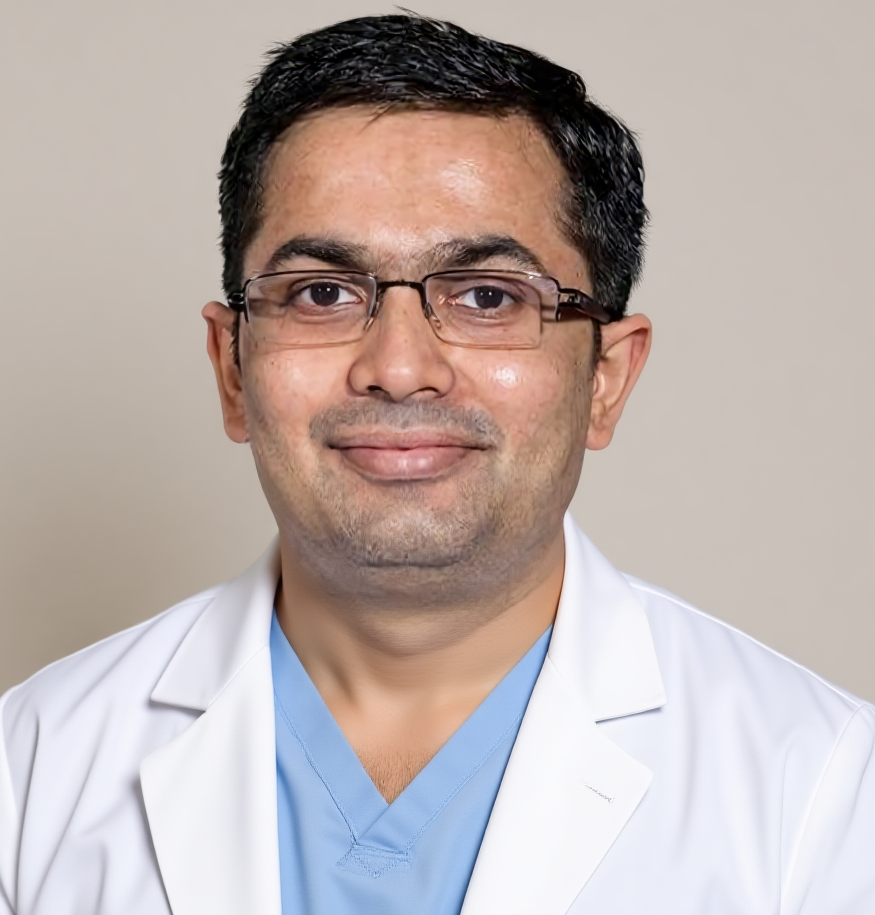
Dr Harsh Shah
MS, MCh (Surgical Gastroenterology), DrNB (Surgical Gastroenterology)
Registered with Gujarat Medical Council, Reg. No. G-38738
Colon Cancer Surgeon
· Apollo Hospital, Bhat, Gandhinagar · Gota OPD, Ahmedabad
Dr Harsh Shah has 18 years of experience in gastrointestinal and cancer surgery. At Apollo Hospital, Bhat the whole colon cancer service sits under one roof: colonoscopy and biopsy, CT and MRI, pathology with MMR testing, medical oncology, stenting, keyhole and open surgery, stoma nursing and follow-up, with every case discussed by the tumour board. Google rating 4.89 from 216 reviews at the Gota clinic, and 4.94 from 17 reviews at the Apollo, Bhat listing.
The left colon runs from the bend under the spleen, down the left side of the abdomen as the descending colon, to the S-shaped sigmoid colon that joins the rectum. Cancer here is planned differently from cancer on the right side: the blood vessels, the operation and, when the disease has spread, some of the medicines are different.
Each segment of the large bowel has its own blood supply and its own chain of lymph nodes, and a cancer is removed together with both. A tumour at the bend under the spleen sits between two territories, so the operation there is chosen case by case.
The lower limit matters too. A growth within roughly fifteen centimetres of the anal opening is a rectal cancer, which follows a different pathway, often with treatment before surgery — so the tumour’s exact level is settled early.
The side also changes treatment when the disease has spread. For cancers that began on the left side and carry no RAS mutation, a targeted medicine against a growth receptor called EGFR is added to chemotherapy; on the right side a different combination is used. So “left colon” on a report is not just a location — it is part of the plan.
No symptom on its own tells colon cancer apart from conditions that are not cancer. Bleeding, a change in bowel habit and anaemia can all have other causes. The question is settled by looking inside with a colonoscopy and taking a biopsy, and the pathology report is the only reliable answer.
The symptoms below are the ones that need the whole colon examined.
| What you notice | Why it needs checking | What settles it |
|---|---|---|
| A change in bowel habit lasting more than four weeks — especially going more often or looser stools | A growth can narrow the bowel and alter how stool passes | Full colonoscopy with biopsy of anything abnormal |
| Blood with a change in bowel habit, or dark blood mixed in the stool | Bleeding from inside the colon, not only from the outlet | Colonoscopy to the start of the colon |
| Iron-deficiency anaemia without an obvious cause, in any man or in a woman after menopause | A tumour can bleed slowly for months without visible blood | Colonoscopy, along with the usual anaemia tests |
| Weight loss without a reason, or a lump felt in the abdomen | Can be the first sign of a larger growth | Colonoscopy and a contrast CT |
| A blocked bowel — swelling, vomiting, no stool or wind — or a sudden burst bowel | A large share of colon cancers in India first show themselves this way | Emergency assessment with CT; treatment first, full work-up alongside |
A full colonoscopy to the very beginning of the colon comes first, with a biopsy and an ink tattoo beside the tumour. A contrast CT of the chest, abdomen and pelvis then stages the disease. A CEA blood test, routine bloods, and a MMR or MSI test on the tumour tissue complete the core work-up before any treatment is planned.
| Order | Test | What it answers |
|---|---|---|
| First | Full colonoscopy to the caecum, with biopsy and an India-ink tattoo beside the growth | Confirms cancer, marks the spot so a small tumour can be found at surgery, and clears the rest of the colon — a second, separate cancer is occasionally present |
| If the scope cannot pass a narrowing | CT colonography, or a completion colonoscopy within a few months of the operation | The part of the colon beyond the blockage is never left unexamined |
| Second | Contrast CT of the chest, abdomen and pelvis | The tumour’s local extent, and any spread to the liver, lungs or abdominal lining |
| Alongside | CEA, blood counts, kidney and liver tests, albumin, clotting | A baseline for follow-up, and the fitness and nutrition picture |
| On every tumour | MMR (by special staining) or MSI testing | Screens for an inherited tendency called Lynch syndrome, and decides some chemotherapy and immunotherapy choices |
| Only if the cancer has spread | RAS and BRAF mutation testing | Chooses the targeted medicine; not needed to treat cancer that has not spread |
| Only when a liver spot is unclear | MRI of the liver or a contrast ultrasound | Characterises the spot. A PET-CT is not a routine test for a new colon cancer |
After the operation, four facts in the pathology report drive the chemotherapy decision: the lymph nodes examined and involved, whether the edges are clear, the MMR or MSI result, and any high-risk feature such as growth through the wall, vessel or nerve invasion, or perforation.
Treatment for left colon cancer is matched to how far the disease has gone. Cancer confined to the bowel wall is usually treated by the operation alone. When lymph nodes are involved, chemotherapy follows surgery. When the cancer has spread to other organs, medicines chosen by the tumour's genes lead, and surgery is added only for selected patients.
| Situation, after the pathology report | Usual treatment | The point to understand |
|---|---|---|
| Cancer in the inner layers of the bowel wall, no nodes involved | Operation alone | No chemotherapy is needed |
| Cancer through the wall, no nodes involved, no high-risk feature | Operation, then observation | The gain from chemotherapy is small, so follow-up is preferred |
| Same, but with a MMR-deficient or MSI-high tumour | Observation — no single-drug chemotherapy | These tumours behave better and do not benefit; the tablet alone may even harm |
| Through the wall with a high-risk feature, no nodes involved | Chemotherapy is discussed, not automatic | A shared decision, written into the record |
| A few lymph nodes involved, tumour not through to the outer surface | Three months of CAPOX chemotherapy | As effective as six months for this group, with far less nerve damage |
| Many nodes involved, or the tumour through the outer surface | Six months of FOLFOX or CAPOX | The longer course is kept for higher risk |
| Spread to the liver or lungs | Chemotherapy with a targeted medicine; removal of the spots for selected patients | Some spread can still be removed completely — a tumour-board decision |
An operation is not the first step for every patient with left colon cancer. Spread that cannot be removed is treated with medicines. A blocked bowel in a frail patient, or one whose cancer has spread, can be opened with a stent instead of an emergency operation. And a patient too unwell for treatment is offered care aimed at comfort.
Spread disease. When spread to the liver, lungs or abdominal lining cannot be removed, medicines chosen by the tumour’s genes are the treatment. If the spots shrink enough, the tumour board looks again at removing them.
A blocked left colon in a frail or advanced patient. A self-expanding metal stent placed through a scope can reopen the bowel. For some patients it is a bridge, so that a planned operation can be done safely a little later without a stoma made in an emergency; for others it is the treatment itself.
Fitness. Fitness is scored at every visit. Fully active patients receive the full pathway; those limited in daily activity may receive a modified plan; for those in bed most of the day, the honest conversation is about comfort and supportive care.
When chemotherapy is not needed. Just as surgery is not always first, chemotherapy is not always next. Many patients with cancer confined to the bowel need nothing after the operation except careful follow-up.
Chemotherapy after surgery should start within six to eight weeks, because the benefit falls when it is delayed. For spread disease, the choice of medicine depends on the tumour's RAS, BRAF and MMR results, and for MMR-deficient tumours an immunotherapy drug now comes first, ahead of chemotherapy.
Before capecitabine or 5-FU, a DPYD test is done where available, because people lacking that enzyme can be harmed by a standard dose. Oxaliplatin can cause tingling and numbness in the hands and feet, which is why the three-month course is preferred whenever it is enough.
For spread disease, a left-sided cancer without a RAS mutation receives chemotherapy plus cetuximab or panitumumab; a RAS-mutated cancer, chemotherapy plus bevacizumab; a BRAF-mutated cancer, its own targeted combination after the first line; and a MMR-deficient cancer, pembrolizumab first. Palliative care and nutrition teams join early — for symptoms and strength, not because treatment has stopped.
The operation removes the cancer-bearing segment of the left colon together with its blood vessel, tied at its origin, and the whole fatty sheet of lymph nodes that drains it. The two ends are then rejoined. Keyhole (laparoscopic) surgery is the standard approach; open surgery is chosen for bulky tumours or those stuck to other organs.
| Where the tumour is | Operation | Vessel tied |
|---|---|---|
| Bend under the spleen, or far end of the transverse colon | Extended left or extended right hemicolectomy | Middle colic, with or without the left colic |
| Descending colon | Left hemicolectomy | Left colic |
| Sigmoid colon | Sigmoid colectomy or anterior resection | Inferior mesenteric, tied high or low |
Three principles apply in every resection. The blood vessel is tied where it starts and the lymph-node-bearing tissue is removed whole, a technique called complete mesocolic excision. At least twelve lymph nodes should reach the pathologist, because fewer than that makes the staging unreliable. And if the tumour is stuck to another organ, that part is removed in one piece with it — peeling a tumour off can leave cancer behind at the edge.
Approach. Laparoscopic surgery is the validated standard: the same cancer operation as open surgery, with a faster recovery. Robotic surgery is an acceptable alternative. Open surgery is chosen for a bulky tumour, other organs involved, or a scarred abdomen — sound judgement, not a failure of keyhole surgery.
Emergencies. A blocked left colon in a fit patient is treated by removing the tumour and joining the bowel, sometimes protected by a temporary stoma, or by a Hartmann’s operation with a stoma when the patient is unstable. A burst bowel needs removal, a wash-out and usually a stoma. Whenever a stoma is possible — even if unlikely — it is discussed and consented for every time, and the stoma nurse marks the right site before the operation.
The complications every patient hears about before agreeing: bleeding; wound infection; clots in the legs or lungs; heart, breathing or anaesthetic problems; conversion to open surgery; a leak from the join; slow return of bowel function; injury to the ureter; an abscess; a temporary or permanent stoma; narrowing at the join; a scar hernia or adhesions later; and a risk to life, higher in an emergency. Dr Harsh Shah explains each of these personally before consent, with the figures that apply to your age, your fitness and whether the operation is planned or urgent — they are individual, not general, and are not quoted on a page. The final stage, and therefore the need for chemotherapy, is known only after the pathology report.
A patient describes recovery after colon cancer surgery with Dr Harsh Shah (in Hindi), shared with consent.
Recovery starts before the operation: anaemia is corrected, blood sugar controlled, smoking and alcohol stopped, and nutrition built up. After a planned keyhole operation, patients sit out of bed on the same day, eat on the first day, walk several times a day, and usually go home within a few days.
Before a planned operation the bowel is prepared with a laxative plus oral antibiotics, which lowers infection and leaks, and a carbohydrate drink is taken unless the bowel is blocked. Malnourished or less active patients get a structured exercise and nutrition programme first. Blood thinners continue at home for four weeks.
There is no routine tube through the nose and usually no abdominal drain; the urine catheter comes out within a day. Going home depends on four things: eating, passing wind or stool, pain controlled with tablets, and walking independently without fever — and, if there is a stoma, being able to change the bag without help.
Warning signs after discharge — fever, a racing pulse, new or worsening abdominal pain, or going backwards after improving — need a call the same day.
About two weeks after surgery the pathology report is discussed and the need for chemotherapy is decided. Follow-up then continues for five years, with CEA blood tests, CT scans and colonoscopies on a planned schedule, because finding a recurrence early gives the most options.
| When | What happens |
|---|---|
| Two weeks | Wound check, the pathology discussion, chemotherapy referral if needed, dietitian and stoma review |
| Every three months for three years | Symptoms, weight, examination and a CEA blood test |
| Every six months in years four and five | The same checks |
| Yearly for three to five years | Contrast CT of the chest, abdomen and pelvis; more often for higher-risk disease |
| One year after surgery | Colonoscopy; if normal, again at three years and then every five years |
| When the tumour is MMR-deficient, the patient is young, or the family history suggests it | Referral for genetic counselling, because relatives may need earlier screening |
A rising CEA with a normal CT is not ignored: it is repeated within weeks and a PET-CT considered.
Colon cancer treatment at Apollo Hospital, Bhat is covered by cashless health insurance, CGHS and corporate schemes, subject to each policy's terms. What changes the estimate is whether the operation is planned or urgent, keyhole or open, the length of stay, whether a stoma is needed, and whether chemotherapy follows. A written estimate is prepared for your own policy.
The hospital’s insurance desk arranges pre-authorisation with a note from Dr Harsh Shah’s office. Ask early how your policy covers day-care chemotherapy and targeted medicines. Bring policy papers, identification and every report.
★★★★★
“(Translated by Google) Dr. Harsh Shah's personality is very nice. He always talks in a good way. He has undergone surgery for colon cancer. Without any problem. Yours faithfully.🙏 (Original) ડૉ હર્ષ શાહ નો સ્વાભાવ ખૂબ જ સરસ છે.તેઓ હમેશા સારી રીત વાત કરે છે .મોટા આંતરડા ના કેન્સર ની સર્જરી એમને કરેલ લી છે. કોઈ પ્રકાર ની તકલીફ નાથી .આપનો અભર.🙏 — Ismailbhai Shaikh, Google review, Gota clinic listing”
★★★★★
“My wife was suffering from colon cancer. Dr harsh shah performed her surgery 1 year back. And now she is cancer free with the grace of almighty and dr harsh shah’s treatment. He treats patients as his own family member. I may blindly tell any patient to approach him. Dr. harsh. Thank you is not enough. My sincere gratitude for all the help and advice you have given to us! — Joseph Sibi, Google review, Gota clinic listing”
★★★★★
“Met with Dr. Harsh Shah for the consultation of one of my relative. Dr. Harsh Shah is an exceptional surgical oncologist in Ahmedabad. His expertise in treating complex GI cancers like liver, pancreas, and colon cancers is truly remarkable. He explains everything clearly and gives patients full confidence in their treatment. Highly recommended for anyone looking for a skilled and compassionate cancer specialist. — Nagesh Patidar, Google review, Gota clinic listing”
Real Google reviews from Dr Harsh Shah’s two listings, reproduced exactly as written.
No. Cancer that has not spread is usually treated by surgery, but spread that cannot be removed is treated with medicines, a blocked bowel in a frail patient can be opened with a stent, and a patient too unwell for treatment is offered care aimed at comfort.
Only if the pathology report shows it is worthwhile. Cancer confined to the bowel wall usually needs none. When lymph nodes are involved, chemotherapy is advised, often for three months; six months is kept for higher-risk disease.
Most planned left colon operations rejoin the bowel without a permanent stoma. A stoma is more likely in an emergency, a blocked or burst bowel, or when the join needs protecting. The possibility is always discussed and consented for before surgery.
It is done on every colon cancer. It screens for Lynch syndrome, an inherited tendency that matters to relatives; it decides whether chemotherapy helps after surgery; and, if the cancer has spread, it can make immunotherapy the first treatment.
Only if the rest of the colon is never examined. A CT colonography before surgery, or a completion colonoscopy within a few months afterwards, checks the part beyond the narrowing for a second growth.
Shah’s Gastro, Cancer & Robotic Surgery Centre
Gota, Ahmedabad, Gujarat
Google rating 4.89 from 216 reviews
Dr Harsh Shah consults at two addresses: the clinic at Gota, Ahmedabad, and Apollo Hospital at Bhat, Gandhinagar.
Patients come from across Gujarat, Rajasthan and Madhya Pradesh; some follow-up tests can be done closer to home and reviewed here.
Have a colonoscopy or CT report that mentions a growth on the left side? The colonoscopy and biopsy reports, the CT and any blood test for CEA can be sent ahead of the appointment so the consultation starts with them already read; the treatment itself is decided at the consultation, after examination. Call +91-63555-64601 · Send the reports ahead on WhatsApp
Swasth Parivar: twice a month, practical advice on recovery, diet and warning signs. No advertising. Stop any time.
Your number is used for these updates and for the clinic to reach you. It is never sold or passed on. To stop, reply STOP on WhatsApp.