Skip to main contentLast updated: 08-Nov-2026
Tapping Book on WhatsApp will likely open the WhatsApp app on your phone.

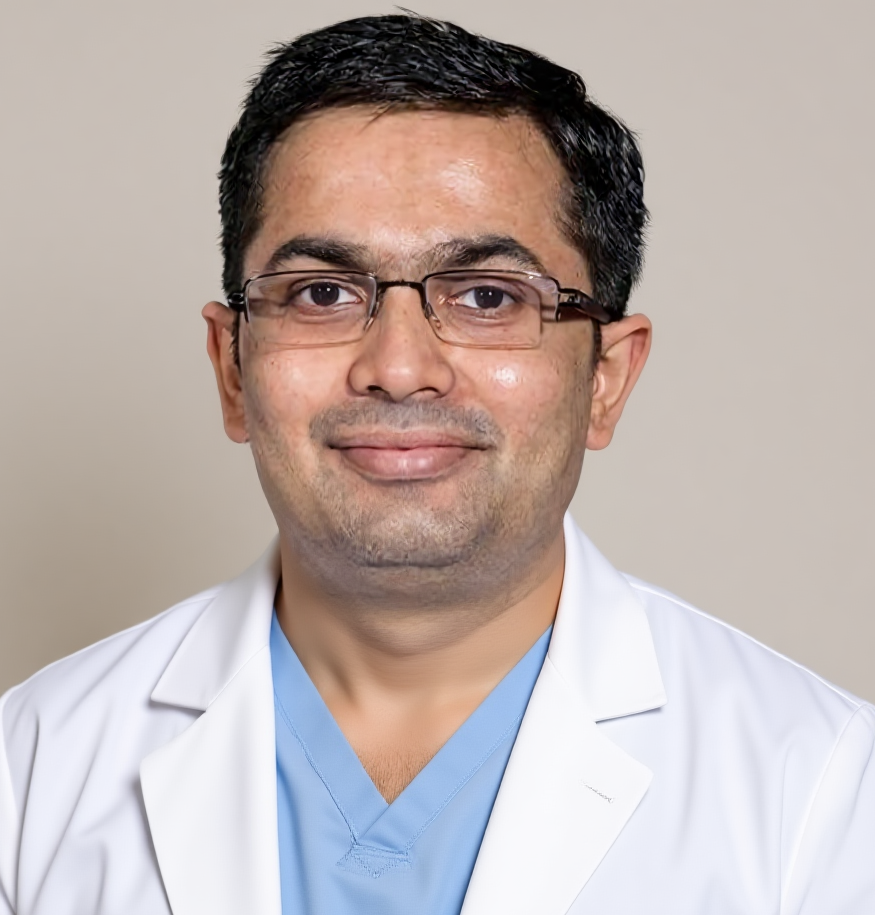
Dr Harsh Shah
MS, MCh (Surgical Gastroenterology), DrNB (Surgical Gastroenterology)
Registered with Gujarat Medical Council, Reg. No. G-38738
Bile Duct & Gastro Surgeon
Dr. Jivraj Mehta Hospital, Vasna, Ahmedabad · 18 years of experience
In short
A bile duct cyst is more than a swollen duct. Years of backflow from the pancreas can change its lining, so it can lead to bile duct or gallbladder cancer.
The risk is low in a young child and rises with age. Removing the cyst early, together with the gallbladder, lowers it a great deal.
Surgery lowers the risk but does not make it zero. So check-ups with scans and blood tests continue for life, even when you feel well.
This post explains the cancer risk. For the full path of a bile duct cyst, from the first scan to treatment, see our choledochal cyst and Caroli treatment page.
The bile duct and the pancreas duct often join in the wrong place. Pancreas juice then flows back into the bile duct and irritates its lining for years.
This faulty join is called an anomalous pancreaticobiliary junction, or APBJ. We describe how it is found in our post on scans for a bile duct cyst. The juice contains strong digestive enzymes. Bile that sits still in the cyst, small stones and repeated infections add to the damage.
The lining reacts step by step. It first thickens, then changes its type, then shows early abnormal cells, and in a few people a cancer forms. This takes years, which is why the risk is small in childhood and larger later.
Two points follow from this:
Yes. The risk is lowest in early childhood and climbs through the adult years, because the lining has been irritated for longer.
This is the most useful fact for a family to know. It leads to two plain rules. A child with a cyst should have it removed early, before years of backflow add up. An adult whose cyst was found by chance should not be told to just watch it, because an adult cyst sits on the steep part of the curve.
| Situation | What happens to the risk | What it means for you |
|---|---|---|
| Cyst found and removed in childhood | Lowest, as little time has passed | Surgery early, then regular check-ups |
| Cyst left in place into adult life | Rises with each decade | Surgery is advised even without symptoms |
| Cyst only drained into the bowel | Stays high, and a new join is added | Removal of the cyst is preferred to a bypass |
| Cyst fully removed with the gallbladder | Much lower, but not zero | Lifelong check-ups |
| Long shared duct with no cyst | The gallbladder is the main concern | Removal of the gallbladder is discussed |
The exact figures differ between studies, regions and age groups, so we do not quote a single number. What every study shows is the same: the risk is far above that of other people, and it grows with age and with a cyst left in place.
The two main cancers are bile duct cancer and gallbladder cancer. Which one appears depends on the cyst type and where the lining is still in place.
The cancer can start in the wall of the cyst itself. It can start in the gallbladder, which is why the gallbladder is always taken out. It can also start in the bile ducts inside the liver, mainly when the cysts reach into the liver, as in Caroli disease. You can read about this in our post on Caroli disease.
The cyst type matters too. The common types in the main bile duct carry the classic risk. A small bulge at the lower end, called a choledochocele, carries a low risk. The pattern of types is explained in our post on bile duct cyst types.
Many patients in India reach a doctor late, as adults. A small number already have a cancer when the cyst is found. So an adult has a CT scan and a CA 19-9 blood test before surgery, and the removed cyst and gallbladder are checked closely under the microscope.
No. Removal lowers the risk a great deal, but it does not end it. Some bile duct lining is always left behind, and so is the new join to the bowel.
After the operation, the duct inside the liver, the upper end of the bile duct and the join to the small bowel are all still there. Our post on cyst removal and the new bile duct join shows how this is done. A cancer can still grow at the join or in the ducts above it, often many years later.
The risk after surgery is higher when:
The first sign is often a new narrowing at the join, yellow eyes, weight loss or a rising CA 19-9. A late narrowing is easily called a simple scar and stretched again and again. In a person with a cyst in their past, it should be treated as a possible cancer until a scan and a sample say otherwise.
Follow-up means clinic visits, liver blood tests, a CA 19-9 test and regular scans. It continues every year for life, even when you feel well.
No single schedule is proven, but the plan below is what most surgeons use. We write it down and give it to you, so any doctor can read it if you move to another city.
| When | Tests | What we look for |
|---|---|---|
| First check after surgery | Liver tests, CA 19-9, ultrasound or MRCP | A starting point to compare with later |
| Every 6 to 12 months in the early years | Visit, liver tests, CA 19-9 | Infection, narrowing, a rising trend |
| At least once a year for life | Ultrasound, and MRCP from time to time | A narrowing, stones in the liver ducts, a lump |
| Any warning sign, at any time | CT or MRI with MRCP, and a look inside the duct if needed | A cancer work-up |
Three habits make this plan work. We look at the trend in the blood tests and not at a single value, because infection can raise CA 19-9 as well. We do scans and not only blood tests, because liver tests can stay normal. And we check more often if you are in a higher-risk group, such as late surgery or cysts in the liver. Our post on complications and check-ups after cyst surgery covers the other problems to watch for.
Yellow eyes, fever with chills, new belly pain, itching or weight loss need a scan soon. Do not wait for the next yearly visit.
Most of the time the cause is a stone or an infection, and these are treated simply. But after a bile duct cyst, we rule out a tumour first. We relax only when the scan is clear.
Plan the lifelong visits now: a family member should know the dates, the tests and where the records are kept. Many patients are young, and the plan has to outlast one hospital.
Yes. Juice from the pancreas can flow back into the bile duct and irritate its lining for years. Over time the lining can change and, in some people, become cancer.
The gallbladder sits in the same area where the juice flows back. Its lining can change in the same way, so it is always removed during cyst surgery.
Usually not. The risk grows with each year the cyst stays in place. So an adult with a cyst is generally advised to have it removed.
Yes, though the risk falls a great deal. Some bile duct inside the liver, the join to the bowel and the pancreas end are still there. They need watching.
Years after surgery, a new narrowing can look like a simple scar but may hide a tumour. So we scan and take samples before we only stretch it.
Often in the first years, then at least once a year for life. The exact plan depends on your age, the cyst type and what was found at surgery.
No. Liver tests can stay normal while a tumour grows. An ultrasound is repeated, and an MRCP is added from time to time.
No. The risk is low in early childhood and rises with age. That is why removing the cyst early is advised.
For questions before you travel, call +91-63555-64601. The pages below cover the next steps.
Dr Harsh Shah — Dr. Jivraj Mehta Hospital, Vasna, Ahmedabad
Dr. Jivraj Mehta Hospital, Dr Jivraj Mehta Marg, Vasna, Ahmedabad 380007.
Consultations, review of reports and scans, operations and follow-up. OPD Monday to Saturday, 9 am to 5 pm.
Appointments: +91-63555-64601 · +91-63590-11009 · Hospital 079-2663 6363
Directions to the hospital · WhatsApp +91-63555-64601
Were you told that a bile duct cyst can turn into cancer, or that you must be watched for life even after the operation? That is a heavy thing to hear, and it needs a calm explanation. Dr Harsh Shah goes through your scans and your surgery notes, and sets up a check-up plan you can keep. Call, or message us on WhatsApp. Call +91-63555-64601 Ask on WhatsApp
Tapping Book on WhatsApp will likely open the WhatsApp app on your phone.
Swasth Parivar: every week, practical advice on recovery, diet and warning signs. No advertising. Stop any time.
Your number is used for these updates and for the clinic to reach you. It is never sold or passed on. To stop, reply STOP on WhatsApp.