Skip to main content
Dr Harsh Shah · Colon Cancer Surgeon · Apollo Hospital, Bhat, Gandhinagar and Gota OPD, Ahmedabad
A right hemicolectomy removes the caecum and the ascending colon with the sheet of fat and lymph nodes that drains them, and joins the small intestine to the remaining colon. It is the standard operation for cancer on the right side of the large bowel. What decides whether it was done well is not the length of bowel taken but three things: the feeding vessels tied at their origin, the mesentery removed whole, and enough lymph nodes in the specimen for the pathologist to stage the disease honestly. Dr Harsh Shah performs it at Shah’s Gastro, Cancer & Robotic Surgery Centre, most often by keyhole surgery.
Shah’s Gastro, Cancer & Robotic Surgery Centre
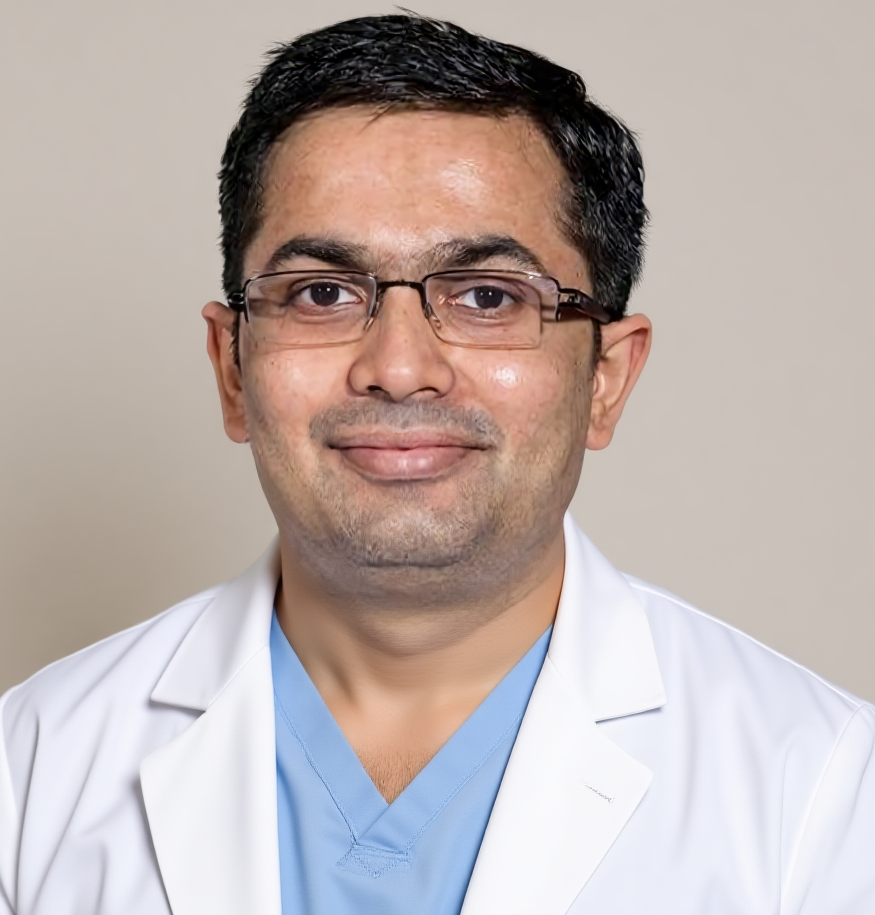
Dr Harsh Shah
MS, MCh (Surgical Gastroenterology), DrNB (Surgical Gastroenterology)
Colon Cancer Surgeon
· Apollo Hospital, Bhat, Gandhinagar · Gota OPD, Ahmedabad
Qualified twice over in surgical gastroenterology and trained in high-volume gastrointestinal cancer units, Dr Harsh Shah operates on colon cancer as routine work. Google rating 4.89 from 216 reviews at the Gota clinic, and 4.94 from 17 at the Apollo Hospital, Bhat listing.
Cancer on the right side of the colon rarely blocks the bowel early, because the contents there are still liquid and the tube is wide. It bleeds slowly instead. So the commonest way a right colon cancer announces itself is not a change in bowel habit but iron-deficiency anaemia — tiredness, breathlessness on the stairs, a haemoglobin that will not stay up on tablets. A lump felt low on the right side of the abdomen is the other presentation.
Iron-deficiency anaemia in any man, or in any woman past the menopause, without an obvious cause is an indication for a colonoscopy, not a prescription for iron. Treating the anaemia and never looking for its source is the commonest way a right colon cancer is delayed in this country.
The two sides also behave differently as diseases: tumours on the right are more often the kind whose DNA repair machinery is faulty, which changes the chemotherapy decision after surgery.
Three investigations are not optional, and an operation planned without them is planned in the dark: a colonoscopy that reached the caecum, a contrast CT of the chest, abdomen and pelvis, and tissue. A scope that could not pass the tumour has not cleared the colon, and a second cancer elsewhere is something the surgeon must know about before the incision, not after.
| Investigation | What it changes |
|---|---|
| Full colonoscopy to the caecum, with biopsy | Confirms the diagnosis and clears the rest of the colon. If the scope cannot pass, the colon above is cleared by CT colonography now or by colonoscopy soon after surgery — never simply dropped |
| India-ink tattoo of the lesion | A small flat cancer cannot be felt through a keyhole instrument. The tattoo is how the surgeon finds it |
| CECT chest, abdomen and pelvis | Stages the disease and shows whether the tumour is stuck to another organ, which changes the operation to an en-bloc one |
| MMR or MSI testing on the tumour | Done on every colon cancer without exception — it screens for Lynch syndrome and decides the chemotherapy conversation afterwards |
| CEA, blood counts, kidney and liver function, albumin | The baseline CEA is what later follow-up is measured against; albumin and haemoglobin decide how much preparation is needed |
| Nutrition screen and performance status | Weight loss, a low body mass index, a low albumin or poor intake each trigger dietitian referral and preoperative optimisation |
A mass in the right lower abdomen is not automatically a cancer, and in India one alternative is common enough that it must be excluded by tissue rather than by impression. Intestinal tuberculosis settles at exactly the same place — the junction of the small intestine and the caecum — and on a scan it can look indistinguishable. Crohn's disease, lymphoma of the bowel wall, an appendix that has filled with mucus, and a large benign polyp all sit in the same differential.
One of these is treated with tablets for months and needs no operation at all, so Dr Harsh Shah will not accept a scan report as the diagnosis when the alternative is treatable without surgery. Biopsies are taken at colonoscopy and sent for the specific tests that separate tuberculosis from cancer, and an unclear picture goes to the multidisciplinary meeting.
A right hemicolectomy takes the last part of the small intestine, the caecum with the appendix, and the ascending colon, together with the mesentery carrying their blood supply and lymph nodes. The ileocolic and right colic vessels are divided at their origin — not near the bowel — so the whole basin of nodes comes out attached to the specimen. The small intestine is then joined to the transverse colon. When the tumour sits at the hepatic flexure or in the proximal transverse colon, the middle colic vessel is taken as well and the operation is an extended right hemicolectomy.
| Where the tumour is | The operation | Vessel divided at its origin |
|---|---|---|
| Caecum, ascending colon | Right hemicolectomy | Ileocolic and right colic |
| Hepatic flexure, proximal transverse colon | Extended right hemicolectomy | The above, plus middle colic |
| Distal transverse colon, splenic flexure | Extended right or left hemicolectomy | Middle, with or without left colic |
| Tumour adherent to another organ | En-bloc resection in one piece | As above, with the adherent part removed attached |
Three standards separate a cancer operation from a bowel operation. The mesentery comes out intact, so the plane holding the nodes is never cut across. At least twelve lymph nodes must reach the pathologist. And a tumour stuck to a neighbouring structure is never dissected off: peeling an adherent tumour away converts an operation that could have removed the disease completely into one that leaves cells behind.
Keyhole surgery is the validated standard for colon cancer: randomised trials compared it directly with open surgery and found the cancer outcomes equivalent, with less pain and a faster return to normal life. A robotic platform is a reasonable alternative in experienced hands. Open surgery remains the right answer for a bulky tumour invading other organs, for a scarred abdomen and for an emergency — and choosing it is an operative judgement, not a failure.
Dr Harsh Shah explains how colon cancer is treated, and what decides whether chemotherapy follows surgery.
Not every right colon cancer goes straight to theatre. Where the disease has already spread, the sequence is decided in the multidisciplinary meeting and chemotherapy may come first, with the bowel operated on later or not at all. Where a small early lesion has been completely removed at colonoscopy and the pathology is favourable, no resection may be needed. Where the patient is too unwell to survive a major operation, the plan changes to what will actually help them.
Two emergencies change the order. A cancer that has blocked the bowel is usually still resected, with the small intestine joined to the colon in the same sitting, because a right-sided join tolerates an emergency better than a left-sided one does. A cancer that has perforated needs resection, washout and usually a stoma — and the perforation itself becomes part of the staging discussion afterwards, whatever the lymph nodes show.
Recovery after a right hemicolectomy follows a defined route rather than waiting for things to happen. Sitting out of bed on the day of surgery, drinking the same evening, eating the next day and walking several times daily are treatments in their own right — they are what returns bowel function fastest. There is no routine tube through the nose and no routine drain in the abdomen after a colonic resection.
Clear fluids on the evening of surgery, a normal diet and four walks on the first day, the catheter out on the first day and a bowel action by the third are the milestones; discharge after an uncomplicated keyhole resection is usually the fourth or fifth day. Discharge is a set of conditions, not a date: eating, passing wind or stool, pain controlled on tablets, walking independently, no fever for a day, and stoma independence where there is a stoma. The rule that matters most in the first week is about going backwards. A racing pulse after a bowel resection is a leak from the join until proven otherwise, and it is never watched overnight.
Every complication is named to the patient and the family before consent is taken. Leakage from the join between the small intestine and the colon is the serious one. Slow return of bowel function is the common one. Injury to the tube draining the kidney, a milky leak of lymph fluid that is specific to this operation, a collection of infection inside the abdomen, the need for a stoma that may be temporary or permanent, narrowing of the join later, a hernia at the wound, obstruction from adhesions years afterwards, and a risk to life itself — all are stated in words, by name.
What is not put on a web page is the number attached to each, because it depends on age, other illnesses, and whether the operation is planned or an emergency. Those figures are given individually at the consent discussion, face to face.
The pathology report answers four questions, and those four answers decide the chemotherapy conversation: how many lymph nodes were examined and how many contained cancer, whether the margins were clear, whether the tumour's DNA repair system is faulty, and whether any high-risk feature is present. Nothing about chemotherapy can be settled honestly before that report exists, which is why the histology discussion is a booked appointment rather than a phone call.
Where lymph nodes contain cancer, chemotherapy after surgery is standard, and for the lower-risk pattern the modern default is a three-month course rather than six — a change driven by a large international collaboration that found the shorter course no worse and far kinder to the nerves in the hands and feet. Where the nodes are clear, most patients need nothing further, and a node-negative tumour with faulty DNA repair is observed rather than given a single fluoropyrimidine drug, because there is no benefit to be had and there may be harm.
Chemotherapy begins within six to eight weeks of surgery where it is indicated, because the benefit measurably falls away beyond that.
Follow-up after a right hemicolectomy has two halves that are easy to confuse. One looks for the cancer coming back: review with a CEA blood test every three months for the first three years, then every six months, with a CT scan of the chest, abdomen and pelvis each year. The other looks for a new cancer elsewhere in the remaining colon, and that is a colonoscopy — at one year after the operation, then at three years, then every five.
The first appointment is at two weeks: wound check, histology discussed in person, chemotherapy referral where indicated, dietitian and stoma review.
A rising CEA with a normal scan is not a reason to do nothing — it is repeated after a few weeks, and a PET scan considered if it keeps climbing. Genetic counselling is arranged where the tumour showed faulty DNA repair, for anyone under fifty, and for a suggestive family history.
A planned right hemicolectomy is admitted at Apollo Hospital, Bhat, and cashless pre-authorisation is opened by the office once the date is fixed; CGHS and corporate panels go through the same office. An itemised written estimate is given before admission. What moves it is whether the operation is keyhole, robotic or open, whether another organ has to be removed with the specimen, room category, length of stay and whether an intensive care bed is needed — which is why a single figure quoted over the phone is a guess.
★★★★★
“My mother underwent colon cancer surgery with Dr. Harsh Shah, and we are extremely grateful for the excellent care she received. The surgery was successful, and she is now recovering well and doing fine. Dr. Harsh Shah is highly skilled, compassionate, and explained everything clearly throughout the treatment. His confidence and dedication gave our family great peace of mind. The entire team was supportive and professional.”
★★★★★
“I underwent surgery under the care of Dr. Harsh Shah. The surgery was done very smoothly and successfully. After the surgery, I am able to perform my daily routine work without any problem. He is very caring, skilled, and supportive throughout the treatment.”
★★★★★
“Dr. Harsh Shah did a great job with my dads colon cancer treatment and surgery. He is quite caring, humble and very detail oriented. He made sure my dad was ready for surgery before operating. His attention to detail is exceptional. My family and I owe him greatly.”
— Mahesh Gabu, Google review, Apollo Hospital, Bhat listing
— Kalabhai Solanki, Google review, Gota clinic listing
— Chirag Mirani, Google review, Gota clinic listing
A patient describes their colon cancer surgery under Dr Harsh Shah in their own words.
Because iron-deficiency anaemia is very often treated as the diagnosis instead of as a symptom. A right colon cancer bleeds slowly into a wide, liquid-filled segment, so it causes anaemia long before it changes bowel habit. In any man, or any woman past the menopause, unexplained iron deficiency is a reason for a colonoscopy.
Usually not. In a planned right-sided resection the small intestine is joined directly to the colon and no bag is needed. A stoma becomes likely where the bowel was obstructed or perforated, or where the patient is too unstable for a join. It can never be excluded in advance, so it is consented for every time and the site marked before theatre.
Because staging is only as good as the specimen. At least twelve nodes must be examined before the pathologist can say with confidence that none contained cancer. If fewer are found, a negative result cannot be trusted, and that itself changes the chemotherapy advice.
By tissue, not by opinion. Intestinal tuberculosis and right colon cancer sit at the same place and can look the same on a scan. Biopsies are sent for the specific tests that separate them, and unclear cases go to the multidisciplinary meeting. If anti-tuberculous treatment is started, it carries a review date at which failure to improve sends you back for tissue.
Not necessarily, and nobody can answer it before the histology. The decision rests on the node count, the margins, whether the tumour's DNA repair system is faulty, and whether any high-risk feature is present. Many patients whose nodes are clear need nothing further. The discussion happens in person at about two weeks, with the report in front of both of us.
Shah’s Gastro, Cancer & Robotic Surgery Centre
Gota, Ahmedabad, Gujarat
Google rating 4.89 from 216 reviews
Dr Harsh Shah consults at Gota, Ahmedabad and at Apollo Hospital, Bhat.
This operation is one part of what a colorectal surgeon does. For the other colon and rectal conditions that are treated, how the first visit works and which reports to bring, read colorectal surgeon in Ahmedabad: what is treated and when to see one.
Been told there is a growth in the right colon or the caecum? Send the colonoscopy report with the biopsy, the CT images themselves, and the haemoglobin trend — that combination usually settles whether an operation is the next step. Call +91-63555-64601 · WhatsApp Dr Harsh Shah's office
Swasth Parivar: twice a month, practical advice on recovery, diet and warning signs. No advertising. Stop any time.
Your number is used for these updates and for the clinic to reach you. It is never sold or passed on. To stop, reply STOP on WhatsApp.